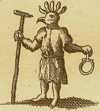
A viewer on our YouTube MuseumZeitraum Channel has raised the question of how Johann Dieter Wassmann’s works came to leave Germany for Washington, D.C. in 1910. The long answer can be found in my essay Sie Kommen on our website, but I’ll try to keep it blog-length here. After the death of Johann’s widow Anna in 1900 from pneumonia, his boxed constructions, photographs, writings and personal archives were stored in 56 crates on the Weimar estate of their daughter Ilsabein and her husband Edward Liszt. Arch-conservative Liszt viewed the works as inflammatory, but out of respect to Ilsabein saw to their proper care. Concerned with inquiries as to their whereabouts from Henry van de Velde, Liszt revealed his cache to Ilsabein’s second cousin, Frederick Wassmann, visiting from Washington, D.C. in 1910, arranging with Frederick for their surreptitious shipment to Washington. In the United States, Frederick could do little to promote the contents of his windfall with the growing spectre of war inciting strong anti-German sentiment. The crates remained in storage until 1930, when they are moved to Harrisburg, Pennsylvania by Gladys and Karl Wassmann, Sr. (pictured left, Karl was Federick’s nephew). Karl, Sr. died in 1966. Gladys died in 1969. In Gladys’ will, a small amount of money was left to establish a foundation, “dedicated to overseeing the scholarship, conservation, publication, exhibition and promotion of the writings, personal archives and constructed works of Johann Dieter Wassmann.” MuseumZeitraum is currently negotiating with The Wassmann Foundation for the repatriation of the works to his native Leipzig.
Thursday, February 01, 2007
Sie Kommen
A viewer on our YouTube MuseumZeitraum Channel has raised the question of how Johann Dieter Wassmann’s works came to leave Germany for Washington, D.C. in 1910. The long answer can be found in my essay Sie Kommen on our website, but I’ll try to keep it blog-length here. After the death of Johann’s widow Anna in 1900 from pneumonia, his boxed constructions, photographs, writings and personal archives were stored in 56 crates on the Weimar estate of their daughter Ilsabein and her husband Edward Liszt. Arch-conservative Liszt viewed the works as inflammatory, but out of respect to Ilsabein saw to their proper care. Concerned with inquiries as to their whereabouts from Henry van de Velde, Liszt revealed his cache to Ilsabein’s second cousin, Frederick Wassmann, visiting from Washington, D.C. in 1910, arranging with Frederick for their surreptitious shipment to Washington. In the United States, Frederick could do little to promote the contents of his windfall with the growing spectre of war inciting strong anti-German sentiment. The crates remained in storage until 1930, when they are moved to Harrisburg, Pennsylvania by Gladys and Karl Wassmann, Sr. (pictured left, Karl was Federick’s nephew). Karl, Sr. died in 1966. Gladys died in 1969. In Gladys’ will, a small amount of money was left to establish a foundation, “dedicated to overseeing the scholarship, conservation, publication, exhibition and promotion of the writings, personal archives and constructed works of Johann Dieter Wassmann.” MuseumZeitraum is currently negotiating with The Wassmann Foundation for the repatriation of the works to his native Leipzig.


Wednesday, January 31, 2007
Portfolio de México
 Our latest short film on the photographic works of Johann Dieter Wassmann, Portfolio de México, has just been released on YouTube. In recent years, Wassmann’s photographic oeuvre has been over-shadowed by his better-known early modernist assemblage works, seen most recently at the Melbourne International Arts Festival. We’re hoping the release of three short films now, and more to come, will allow his wide-ranging achievements to receive their just due.
 In the spring of 1897, the University of Leipzig lecturer, sewerage engineer and artist traveled to Mexico City and Havana to advise authorities on the prevention and control of infectious disease. Wassmann’s pioneering work in the field was long recognized in the Americas, having acted as consulting engineer on Washington, D.C.’s waste management system during Reconstruction. The essential nature of his profession allowed Wassmann exceptional access to the lane-ways and by-ways of both cities, thus providing fodder for his photographic studies. On his return to Leipzig, Wassmann successfully processed over 100 glass-plate and nearly 200 roll-film negatives, although few of these images were printed during his life-time. Nine months later, he died from complications caused by a tram accident.
Quoting here from Wassmann Foundation director, Jeffrey D. Wassmann, "It was Johann Dieter Wassmann’s disillusionment with the industrial progress of the 19th century that led to his private forays into assemblage and photography. In 1881, he set out to combine his father's vocation -- carpentry -- with objects and images he collected for their innate, but often enigmatic qualities, creating boxed works that trace his speculations on an unsettling new world.
“This body of work built on the tradition of German wunderkammern and 17th century Dutch perspective boxes to draw the viewer into the mind of a most ubiquitous thinker.
"Throughout the 1890s, Wassmann continued to expand the visual vocabulary of his assemblage works, but he also began to experiment with photography, using both a bulky glass-plate view camera, as well as several of the newly developed hand-held roll-film cameras. Over an eight-year period he documented the landscapes, streetscapes, architecture and interiors of eastern Germany, in a style that extended beyond the topographic traditions of the day."
"The photographic works of Johann Dieter Wassmann provide the missing link between the meticulous, but still largely prescriptive street imagery of mid-19th century photographer Charles Marville, and the lyrical melancholy of Eugene Atget in the early 20th century. As a predecessor to his fellow countrymen Heinrich Zille and August Sander, Johann discreetly anticipated what vast potential the photographic arts held for the modernist era."
Saturday, January 27, 2007
Vorwarts!
 Sorry for abandoning my post(s) lately, but here at MuseumZeitraum we've been busy creating more short films on the work of Johann Dieter Wassmann for your viewing pleasure, which you'll find on YouTube. Vorwarts! (Go Forward!) is our latest effort, a commentary on Johann's anxiety at the accelerated rate of 'progress' in the late nineteenth century. You might also be interested in having a look at our newMuseumZeitraum Channel on YouTube.
 For even more serious film-going, I'm off to the Berlin Film Festival next week. I'll also be catching up with Richard Moore in Berlin, director of the Melbourne International Film Festival, who in his other role as independent film-maker is currently producing The Foundation, a documentary on the life and work of Johann Dieter Wassmann and our efforts here at MuseumZeitraum to repatriate his collected works home to Germany. I'll keep you posted on both matters.
Monday, January 22, 2007
Paris-Vienna-Düsseldorf (TEE)
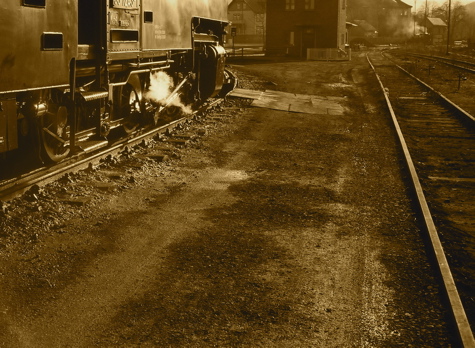 After a busy week trying to tell one Ken Burns effects from another, I’ve wrapped my first iMovie in these wee hours, bringing the early modern photographs of Johann Dieter Wassmann, to the music of Kraftwerk, (yes Kraftwerk). The seven-minute short film uses the rarely seen images Johann captured from moving trains with his hand-held roll-film camera in 1897. I do hope I’ve conveyed some sense of both the angst and excitement Johann experienced with the onset of ‘progress’ represented by the iron horse. Paris-Vienna-Düsseldorf (TEE) can now be seen on YouTube.
 Astute viewers may recognize many of these photographs from the ARIA award-winning jazz CD Before Time Could Change Us by Australia’s premier jazz composer and pianist Paul Grabowsky. Mr. Grabowsky, who has written the music for the films of directors Paul Cox, Fred Schepisi and Gillian Armstrong, has agreed to write the score for the upcoming documentary The Foundation, celebrating the life and work of Johann Dieter Wassmann (Richard Moore: producer).
Friday, January 12, 2007
Mexico City 1897
 Johann Dieter Wassmann, untitled, Mexico City, 1897. Albumen silver print, 230 x 180mm, WF 897026.
In keeping with my last post, I wanted to quietly close out the week with a look at one of the great early-modern photographic works of Johann Dieter Wassmann.
Friday, January 05, 2007
Maybe it’s the toner
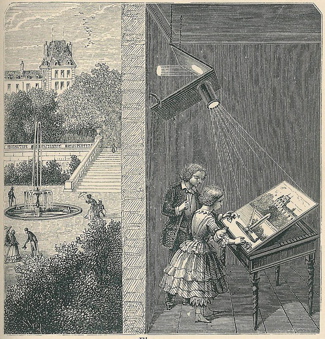 The passing of Ruth Bernhard last month at the prime age of 101 (see my December 21 post) left me pondering through the holidays the remarkable longevity of the great modernist photographers. By my reckoning, there is something in either the lifestyle or the chemical exposure of black-and-white photography that offers a fountain of youth to us all. Excluding combat photographers (e.g. Robert Capa), the life expectancy of this esteemed group is so far beyond the norm as to warrant inquiry by some public health official or PhD candidate. So to get them started, here’s my list of the top 25 by longevity, which would be very close to my list of the top 25 photographers of the 20th century. I’ve included country of birth, to make the point there’s no clear pattern of gender, race or national origin that might be skewing the figures. Photographers noted in bold are still alive, well and I believe working:
 Ruth Bernhard (USA) 101
Manuel Alvarez Bravo (Mexico) 100
Alfred Eisenstaedt (Prussia) 96
Henri Cartier-Bresson (France) 95
Lotti Jacobi (Germany) 94
Edward Steichen (Luxembourg) 94
Helen Levitt (USA) 93
Imogen Cunningham (USA) 93
Bernice Abbott (USA) 93
Gordon Parks (USA) 93
Horst P. Horst (Germany) 93
Frederick Sommer (Italy) 93
Yousef Karsh (Canada) 93
Andreas Feininger (France) 92
Jacques-Henri Lartigue (France) 92
Andre Kertesz (Hungary) 91
Irving Penn (USA) 89
Aaron Siskind (USA) 88
August Sander (Germany) 87
Harry Callahan (USA) 87
Roy DeCarava (USA) 87
Man Ray (USA) 86
Paul Strand (USA) 86
Brassai (Transylvania) 85
Hiroshi Hamaya (Japan) 84
Twelve worlds of wonder
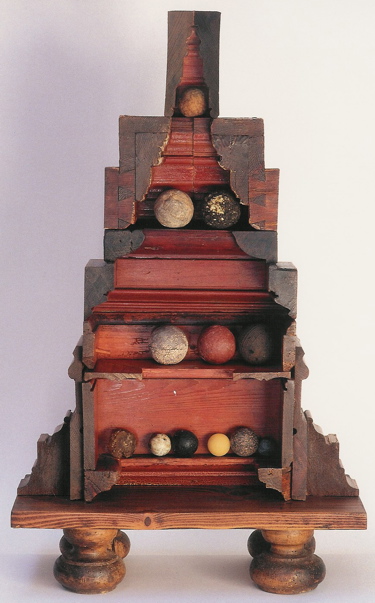 Johann Dieter Wassmann, L’Hotel des Spheres, 1896. 800 x 490 x 240mm. My final gift in the Twelve Days of Christmas. Whew!
Thursday, January 04, 2007
Eleven tiny bee hives
 Johann Dieter Wassmann, L’Hotel de l’Abeille, 1888. 310 x 300 x 150mm. Day eleven in the Twelve Days of Christmas.
Wednesday, January 03, 2007
Ten Qualifiers sitting in judgment
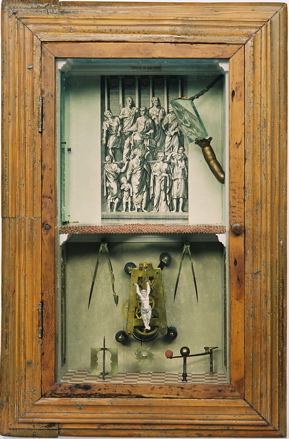 Johann Dieter Wassmann, Eppur Si Muove, 1888. 800 x 530 x 250mm. Day ten in the Twelve Days of Christmas.
Tuesday, January 02, 2007
Nine jewels among many
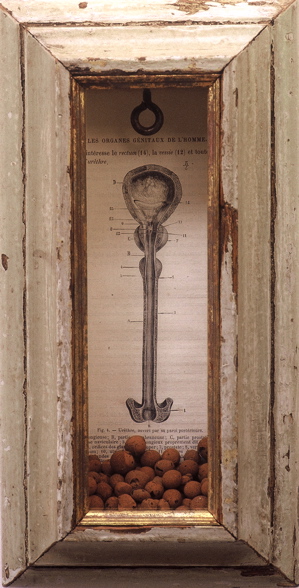 Johann Dieter Wassmann, Les Organes Genitaux de L’Homme, 1897. 360 x 185 x 90mm. Day nine in the Twelve Days of Christmas.
Monday, January 01, 2007
Eight thoughts asunder
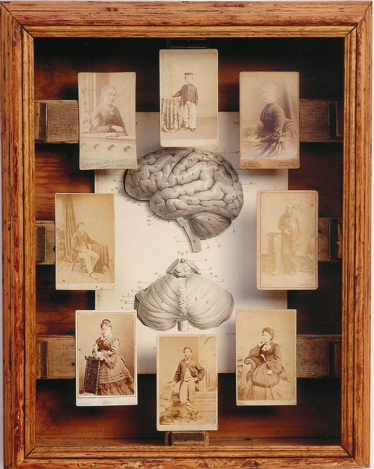 Johann Dieter Wassmann, The Criminal Mind (after Sydney), 1897. 510 x 405 x 150mm. Day eight in the Twelve Days of Christmas.
Sunday, December 31, 2006
Seven shiny marbles
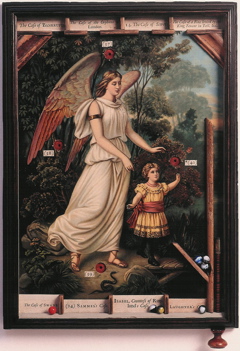 Johann Dieter Wassmann, Guardian Angel, 1888. 660 x 450 x 60mm. Day seven in the Twelve Days of Christmas.
Saturday, December 30, 2006
Six moments passing

Johann Dieter Wassmann, Der Unsterblicher (The Immortals), 1890. 610 x 420 x 120mm. Day six in the Twelve Days of Christmas.
Friday, December 29, 2006
Five traits to ponder
 Johann Dieter Wassmann, Chaste, Grace, Avarice, Mirth & Lust, 1897. 440 x 350 x 150mm. Day five in the Twelve Days of Christmas.
Thursday, December 28, 2006
Four Medicean Stars
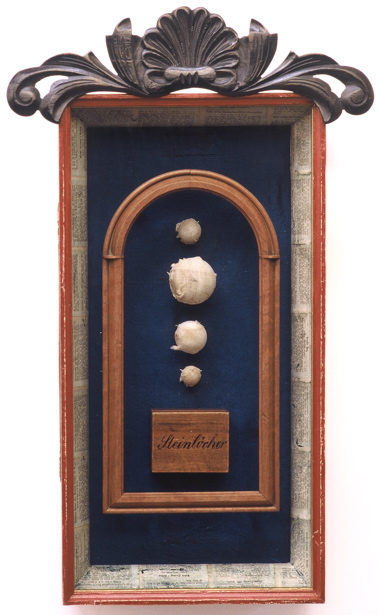 Johann Dieter Wassmann, Steinlocher, 1895. 640 x 395 x 115mm. Day four in the Twelve Days of Christmas.
Wednesday, December 27, 2006
Three noble virtues
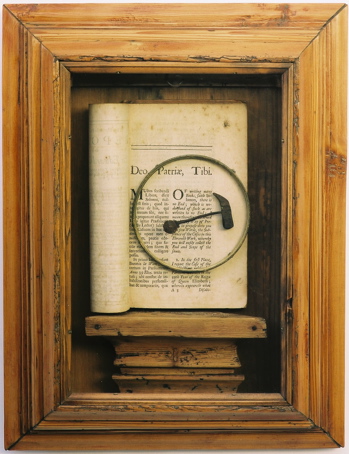 Johann Dieter Wassmann, Deo, Patriae, Tibi, 1890. 500 x 380 x 10mm. Day three in the Twelve Days of Christmas.
Tuesday, December 26, 2006
Two martrys in an elm tree
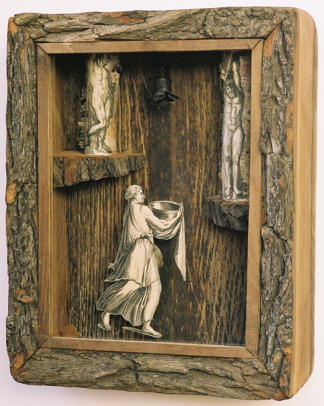 Johann Dieter Wassmann, Et in Arcadia Ego II, 1888. 350 x 280 x 120mm. Day two in the Twelve Days of Christmas.
Monday, December 25, 2006
The Twelve Days of Christmas... a child is born
 Johann Dieter Wassmann, L'Enfant Moses, 1893. 335 x 250 x 155mm.
 Throughout Christendom, the Twelve Days of Christmas begins this evening. To celebrate, I will present a gift each day of the lesser-known works of Johann Dieter Wassmann. Here Johann depicts not the baby Jesus, but Moses on the River Nile. From inside a protective jar he peers out at a duck egg, from which the artist would appear to suggest the infant has recently emerged.
Sunday, December 24, 2006
Eppur Si Muove
 The Australian film-maker Richard Moore sent along word overnight that a trailer from his upcoming documentary The Foundation can now be seen on YouTube. While the clip focuses on Wassmann Foundation director Jeff Wassmann, Richard assures me the final cut of the film will examine more broadly the life and art of Johann Dieter Wassmann, along with the efforts of MuseumZeitraum to repatriate Johann’s works home to his native Leipzig.
Thursday, December 21, 2006
Ruth Bernhard 1905 - 2006
 Ruth Bernhard, Chicago, Illinois, 1981. Photograph: Sophie Vogt.
Earlier today, I learned of the passing of Ruth Bernhard in San Francisco at the age of 101. When I first met Ruth in 1981, she was already 76 but I had little doubt she had 25 good years left in her. She has proven me correct. With an iron will and unswerving modernist convictions, Ruth was truly one of the greats of 20th century photography. She will be remembered as an inspired teacher and mentor to many, including myself.
Born in Berlin in 1905, Ruth studied at the Academy of Fine Arts before following her father to New York in the 1920s. A decade later, she headed west to Hollywood where she met Edward Weston, who would become her dear friend and soul-mate. Ruth soon reduced the nude to pure essence, creating several of the most iconic images of the female form of the modernist era, most notably In the Box, Horizontal 1962.
I first met Ruth in Chicago when she was touring with Margaretta K. Mitchell’s exhibition Ten Women of Photography. Accompanying her were two other greats of 20th century photography, Lotte Jacobi and Barbara Morgan. All are gone now, but the legacies of their kindness, vision and pioneering spirit will outlast us all.
Here’s a link to Ruth’s obituary in this morning’s Los Angeles Times.
Monday, December 18, 2006
Zaha Hadid's crystal ball
 Earlier this morning I had a breakfast meeting with executives at BMW's ultra-modern Zaha Hadid-designed Leipzig car plant as the Zeitraum Challenge spreads its wings in search of support to assure MuseumZeitraum reaches its full potential. While all talks remain confidential, I can say, what a remarkable place to go to work every day. Time to give up curating and start punching the clock. Here's a link with a look into the future of the workplace.
Friday, December 15, 2006
L'Origine du monde
 Johann Dieter Wassmann, SCHLOSS, AUGUSTBURG, 1897. Albumen silver print, 18 x 23 cm, WF 725014.
With the first forecast of snow in the coming days and Miami long forgotten, I thought I'd end the week with this rather suggestive, if brutalist, image -- bearing a clear reference to Courbet's L'ORIGINE DU MONDE, 1866 -- from the archives of The Wassmann Foundation, Washington, D.C.
Sunday, December 10, 2006
If art matters
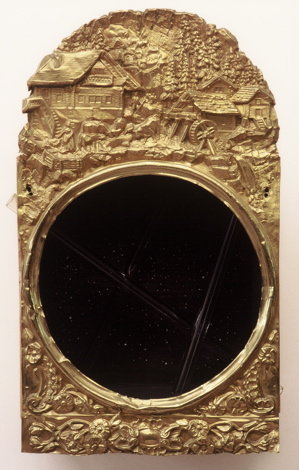 Johann Dieter Wassmann, ZEIT-RAUM, 1896. 470 x 270 x 160mm.
I suspect few of the 40,000 heading home this weekend from Miami Basel chose the window seat for their return travel (excepting, of course, locals, those with private jets and those for whom the window seat was the last remaining in first class). It’s not a ‘window seat’ kind of crowd. Watching the lights of the Brittany coastline twinkle below on my way in to Frankfurt, I pine for the days when it was otherwise. I struggle to imagine Joseph Beuys strutting his stuff daily on South Beach, with his entourage in tow, or Marcel Duchamp screaming “I HAVE a reservation,” at Joe’s Stone Crab, both events I witnessed by artists who shall remain un-named. Art Basel Miami Beach is strictly Warhol territory, as is the art-world at large today.
Were Johann Dieter Wassmann to reincarnate himself in the present, I have little doubt he would be sitting in the window seat, as I am. Looking out through this tiny porthole into the night sky at 37,000 feet, I’m reminded of his work ZEIT-RAUM, the namesake for our museum dedicated to his life’s work. ‘Space-Time’, both as a work and as an institution, is a portal of sorts, a suspended moment that takes us from the mundane of everyday life into a slipstream of possibilities, where art is our chosen mode of transport and hope and dreams remain unbounded, not simply a tool for capital gain.
When I land in Frankfurt, I’ll have a three-hour delay before heading home to Leipzig, time enough to send this post and dash over to the Städelsches Kunstinstitut to spend another treasured moment with Vermeer’s GEOGRAPHER. Another time, another place, but a portal like no other. If art truly matters, this is still the reason why.
Friday, December 08, 2006
Welcome to the machine
 Given my life as a curator, rather than collector or critic, my intent in coming to Art Basel Miami Beach had been to engage in the discourse of the event, rather than wallow in celebrity, parties and gross revenues. How silly of me.
 There is no discourse in Miami. There is only money. While I’m not often prone to admit it, Robert Hughes was right about one thing. As he told The Guardian earlier this year, "The present commercialisation of the art world, at its top end, is a cultural obscenity.” Nothing could better describe these past few days, time spent in such vapid pursuits they're hardly worth reporting. The few programmed events that had promised more, such as the Conversation series, were either cancelled (Jacques Herzog was a no-show) or simply banal (a discussion this morning on what else – collecting).
So if you didn’t make it to Miami, don’t fret. My advice: from now till summer, put aside $10 a day (less if you live in Europe) and head to Kassel for Documenta 12, the last holdout on the art circuit where 'dis-course' doesn't refer to a pudgy-fingered New Yorker pointing to what he wants off the luncheon menu.
Thursday, December 07, 2006
Vernissage Art Basel Miami Beach
 Pictured: Artist Sally Smart at Jacob Karpio Galeria (Costa Rica)
Art Basel Miami Beach is to art appreciation what Pamplona is to animal welfare. They also launch themselves in much the same manner. And the bulls are certainly running this evening here at ABMB’s Vernissage (brought to you in real time via BlackBerry). It would be doing no one justice to offer critique amidst such a well-groomed stampede, nor would it do me much good to continue nursing this metaphor. I will say, however, that the stand-out artist on first look is Sally Smart, an Australian showing at Jacob Karpio. Her ‘Exquisite Pirate’ installation, an expansive work exploring the discourse of women pirates (shown at ABMB on reduced scale) has been the talk of New York since Jerry Saltz’s rave about her in The Village Voice earlier in the year when the work was shown at Postmasters. The installation is currently on view at Jacob’s San Jóse gallery; an all-new work on the theme is set to open at Hunter College’s mid-town gallery next month. We would hope to see her across the pond sometime soon. First we take Manhattan, then we take Berlin?
You won’t find Smart listed on ABMB’s web catalogue, as we suspect she was a late ring-in, but here’s a link to her own website:
Wednesday, December 06, 2006
Hot, hot, hot
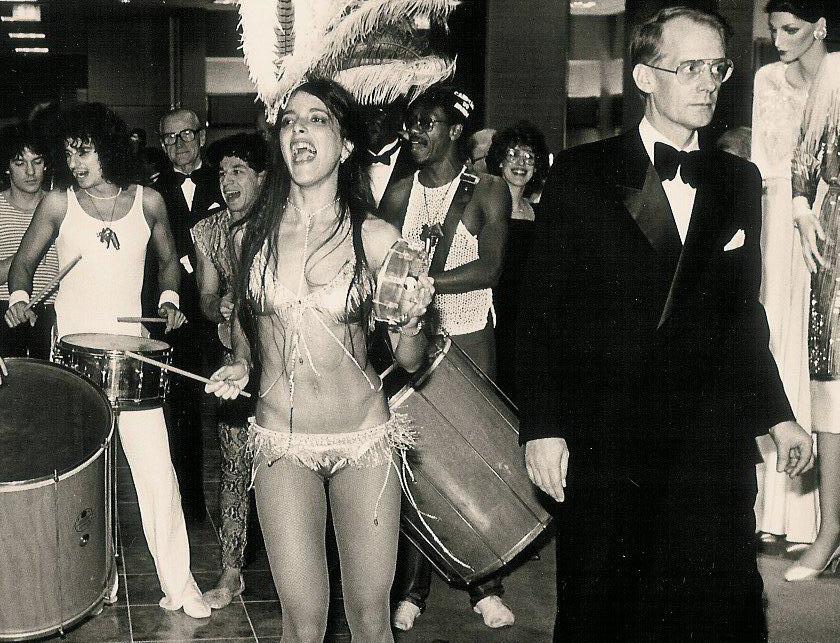 Art Basel Miami Beach doesn’t officially open until Thursday, but the art of commerce has been well under way for several days. Earlier this evening, I stopped by the UBS party on South Beach, where Tyler Green enthusiastically explained to me, “Miami is the new Davos.” Less the protesters, Tyler.
 Landing in Miami mid-day, the tarmac was already crammed with private jets hunkered down for the week. Curbside, BMW’s fleet of 25 chauffeured 7-series motor cars was busy ushering VIP guests to and fro -- indeed, die dynamischste Limousine der Oberklasse. I might have caught a glimpse of Dennis Hopper gliding away in one, but I can't be certain.
What a difference a year and a mid-term election make. 12 months ago, we ‘old’ Europeans were on the receiving end of profuse apologies for the actions of The Great War-Monger, as Borat hails him. Today, it’s victory to the left and the war seems largely forgotten. Too bad no one told those poor sods still in the trenches, the ones who forgot to go to Yale, that the war is resolved. Might I remind you, it isn't.
Oh yes, if you were hoping to learn something about art in Miami, I haven’t spotted any yet, just commerce. Tomorrow's another day.
Sunday, December 03, 2006
Miami FLA...

Like the lemming that I am, it’s Frankfurt-to-Miami via Dulles later today for the madness of Art Basel Miami Beach. Monday and Tuesday, I’ll be stopping through Washington, D.C., as negotiations continue with The Wassmann Foundation to repatriate the works of Johann Dieter Wassmann home to his native Leipzig. Technology, immigration and sobriety permitting, I’ll do my best to keep you posted through the week.
Friday, December 01, 2006
Freundschaftstempel
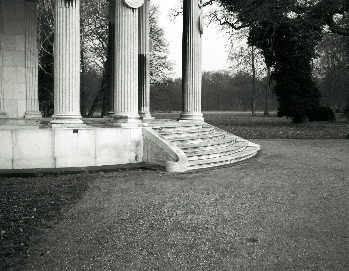 JOHANN DIETER WASSMANN, Freundschaftstempel, Potsdam, 1896. Albumen silver print, 18 x 23 cm, WF 743020.
Regular readers will know Fridays I prefer to let the picture tell the story. Here's a picture as charming as they come to help ease into the weekend.
Tuesday, November 28, 2006
Leipzig Holocaust Museum
The #1 topic of discussion in Leipzig art circles this week has been the announcement by city officials of approval for a new Holocaust museum, to be built in the former Soviet pavilion on the grounds of the old Leipzig trade fair. Developers had previously hoped to build a multiplex cinema in the pavilion, with its church-like steeple topped by a massive red star.
Renowned German architect Meinhard von Gerkan has been selected to design the project. Von Gerkan was responsible for Berlin’s new central rail station and is currently involved in planning a new Chinese city outside Shanghai, as well as designing several soccer stadiums in South Africa for the 2010 World Cup.
Planners feel housing the museum in the former Soviet pavilion will allow the institution to expand discussion beyond the Holocaust, to anti-Semitic oppression during the Soviet era, a period in which many surviving Jewish leaders were sent to labour camps or into exile. In an interview in Die Zeit, historian Frank Nesemann of Leipzig’s Simon Dubnow Institute for Jewish History and Culture said he believed broadening the dialogue to include the state-sanctioned anti-Semitism of the GDR and Soviet Union will contribute to our understanding of the rise of genocidal regimes.
There’s an English-language story in Deutsche Welle, but it focuses primarily on the architect. Here’s a link to a more comprehensive story in the European Jewish Press.
Renowned German architect Meinhard von Gerkan has been selected to design the project. Von Gerkan was responsible for Berlin’s new central rail station and is currently involved in planning a new Chinese city outside Shanghai, as well as designing several soccer stadiums in South Africa for the 2010 World Cup.
Planners feel housing the museum in the former Soviet pavilion will allow the institution to expand discussion beyond the Holocaust, to anti-Semitic oppression during the Soviet era, a period in which many surviving Jewish leaders were sent to labour camps or into exile. In an interview in Die Zeit, historian Frank Nesemann of Leipzig’s Simon Dubnow Institute for Jewish History and Culture said he believed broadening the dialogue to include the state-sanctioned anti-Semitism of the GDR and Soviet Union will contribute to our understanding of the rise of genocidal regimes.
There’s an English-language story in Deutsche Welle, but it focuses primarily on the architect. Here’s a link to a more comprehensive story in the European Jewish Press.
Monday, November 27, 2006
My Weimar weekend
 Johann Dieter Wassmann, GOETHEHAUS, WEIMAR, 1894.
 Albumen silver print, 18 x 23 cm, WF 736004.
The weekend saw a trip to Weimar, where I celebrated an American Thanksgiving (two days late) with senior staff from The Wassmann Foundation, including director Jeff Wassmann, at the city’s celebrated Hotel Elephant. Despite its role as the epicenter of German Enlightment, Weimar remains as intimate and cozy as it must have been then, all the more so in autumn.
The highlight for me, however, was a short stroll over to the grounds of the first Bauhaus School, originally designed as the School of Arts and Crafts by Henry van de Velde in 1907. A nephew of Johann Dieter Wassmann was one of the carpenters responsible for the iconic spiral staircase in what is now the College of Architecture, Building and Construction. This central building, recently renovated to its early glory, always guarantees me goose bumps, as a life-long student of modernism.
No less inspiring was my pilgrimage to Goethe’s home, now a museum, pictured here in a photograph by Johann in 1894. Unfortunately, the Nietzsche Archives was closed when we popped by, but the stunning Art Nouveau building was worth a peak through the gate all the same.
The good news is that I can report we appear one step closer to completing a repatriation agreement with the Wassmann Foundation, bringing the works of Johann Dieter Wassmann long-last home to Leipzig. Stay tuned…
Wednesday, November 22, 2006
Nietzsche 306P
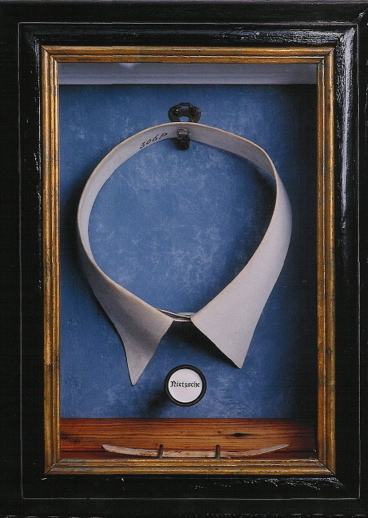 Johann Dieter Wassmann, NIETZSCHE 306P, 1897. 370 x 280 x 100 mm.
 The lesser-known companion piece to yesterday's post, IN THE STAR CHAMBER, is Johann's provocative work, NIETZSCHE 306P.
In 1889, Nietzsche suffered a mental breakdown, often attributed to his contraction of syphilis, resulting in his admission to various clinics before he was moved to Naumburg, where his mother looked after him until her death in 1897. At that point his sister Elisabeth shifted him to Weimar, where she continued his care, as well as promoting his legacy and allowing the occasional audience with guests until his death in 1900.
It was in Weimar that Johann briefly visited Nietzsche, but finding only a shell of a man he returned home to produce this work, depicting simply and eloquently the empty collar of the man, an organ stop with the name 'Nietzsche' printed on it, and an opium-stained bone apothecary spoon. The objects are placed against a dappled blue wall, reflecting Nietzsche's penchant for blue-lensed spectacles.
Our thoughts go out today to the family of Nietzsche's most recent biographer, Curtis Cate, who we understand passed away earlier this week in Paris at the age of 82. The New York Times is preparing an obituary for publication in the next few days. In the meantime, here's a link to the Times review of Curtis's biography, FRIEDRICH NIETZSCHE (Overlook Press), from August of last year.
Tuesday, November 21, 2006
In the Star Chamber
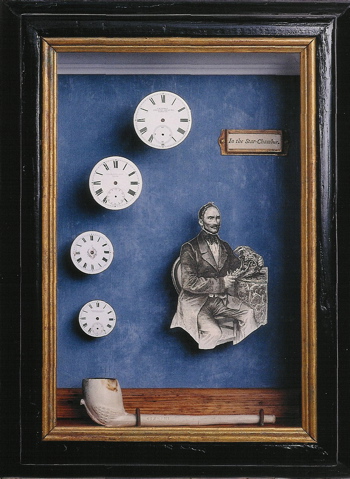 Johann Dieter Wassmann, IN THE STAR CHAMBER, 1897. 380 x 280 x 100 mm.
 Looking back over the past couple weeks I see a pipe theme developing, so I thought I'd continue with this pre-Surrealist motif by presenting what is arguably Johann's best-known work, IN THE STAR CHAMBER.
Saturday, November 18, 2006
16969
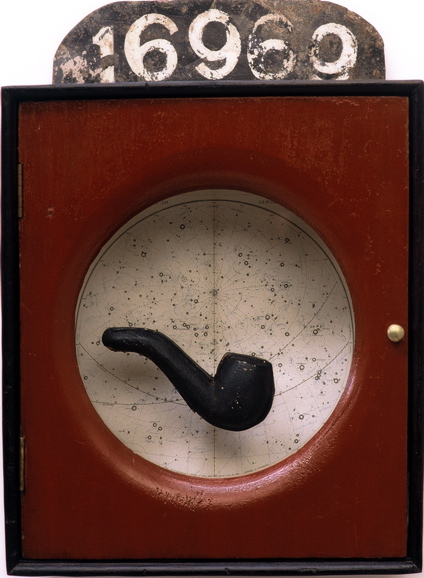 Johann Dieter Wassmann, 16969, 1896. 440 x 310 x 150 mm.
 By request, I'm posting an enlarged view of the central work in the installation "Planck's Constant", which I showed you Thursday. The piece is currently in the collection of The Wassmann Foundation, Washington, D.C., pending finalisation of a repatriation agreement that will see the works of Johann Dieter Wassmann return home to Leipzig for our July 2008 opening (preferably with time to spare).
Thursday, November 16, 2006
Planck's Constant
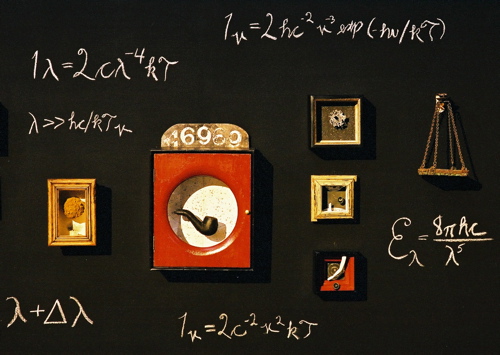 Here's a look back at "Planck's Constant", last seen in 1998 at The Wassmann Foundation’s Centennial Exhibition in Washington, D.C. The installation explores the intellectual convergence that occurred through Johann Dieter Wassmann's friendship with the physicist Max Planck. The installation will be restaged at MuseumZeitraum Leipzig’s inaugural exhibition in 2008.
Monday, November 13, 2006
MuseumZeitraum construction update
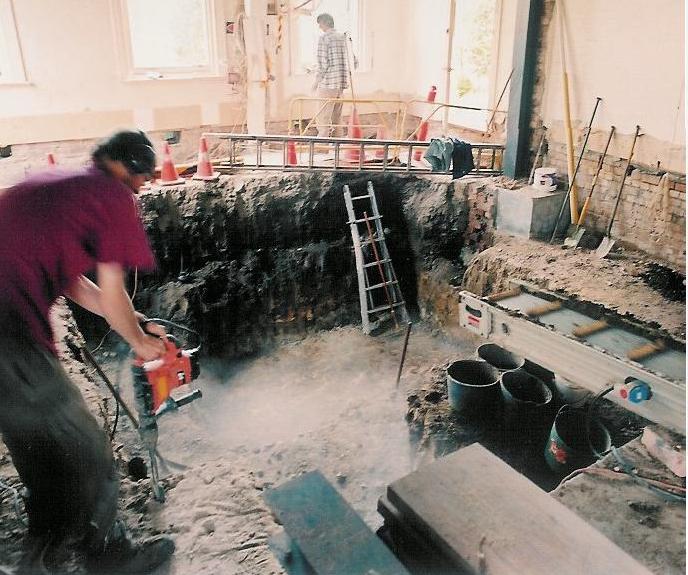 I've realised I'm long overdue for an update on MuseumZeitraum's construction progress. Here's a look at the sub-basement, which will one-day house the museum's archives. Finance and final architectural plans are pending, but we're still on track for our summer 2008 opening (fingers crossed). For an exterior view, have a look at my August 24 post.
Thursday, November 09, 2006
Mut zur Lücke
 Johann Dieter Wassmann, PRINCE OTTO VON BISMARCK, 1896. 660 x 530 x 130 mm.
The recent release of Rohan Kriwaczek’s AN INCOMPLETE HISTORY OF THE ART OF FUNERARY VIOLIN (Overlook Press) has prompted several commentators to disparage the Guild of Funerary Violinists as something of a 'pre-modern' relic. This points up a significant misunderstanding of the role of the funerary violinist in the development of the modern era, a misunderstanding that warrants further discussion.
Pope Gregory XVI’s instigation of the Great Funerary Purges of the 1830s and 1840s was a deliberate, and it must be said effective, strike at the spartan musical form advocated by funerary violinists, a form that we now appreciate revealed the buds of early modern intellectual independence. As Kriwaczek rightly points out (see Wednesday's post), “…the genre of Funerary Violin evolved in its own distinct manner, following a path of rooted modality and direct expression, and eschewing all displays of virtuosity… in order to explore simply and honestly our relationship with our own and others’ mortality.” This reductivist urge, which I might also add was largely devoid of narrative, was a radical departure by any measure, but like the electric car in our current age, powerful forces made certain it was not to be, at least not yet. When it did find a foothold in the late 19th century, success was the domain of others.
In the visual arts, a similar reductivism came to inform the boxed works of Johann Dieter Wassmann in the 1890s. Not surprisingly, Johann’s elder brother, Hugo Wassmann, was himself a funerary violinist, as I have mentioned. In her essay, "A Carpenter's Tale," Maime Stombock points out that it was Johann’s sudden and humiliating recognition in 1889 of the depth of his own bourgeois values that long last allowed the fog to lift:
"The final period of work that grew out of these revelations can only be described as early modern. Johann's competence as a carpenter, along with his total command by this point of the medium of the wooden box, allowed him to plunge headlong into works unlike anything he had considered prior. The most striking feature of these pieces is their simplicity of line, plane and form. This new sensibility he referred to by the German expression die Mut zur Lücke -- the courage to leave things out. Several works even verge on abstraction, most notably his politically charged pair KAISER WILHEM II, 1894 and PRINCE OTTO VON BISMARCK, 1896. The enigma of these works, an enigma which creates puzzlement even today, rests in the subtlety of their comment, rather than in the compelling presence of a narrative, as was often the case in earlier works."
READ MORE
Wednesday, November 08, 2006
The Art of Funerary Violin
 A post-election day reading from Rohan Kriwaczek’s AN INCOMPLETE HISTORY OF THE ART OF FUNERARY VIOLIN (New York: Overlook Press, 2006):
 “(T)he genre of Funerary Violin evolved in its own distinct manner, following a path of rooted modality and direct expression, and eschewing all displays of virtuosity, in terms of both performance and compositional artistry, in order to explore simply and honestly our relationship with our own and others’ mortality, in all its many and varied historical and cultural aspects. Had it survived until today, who knows how it would have reflected our current disowning of death; however, it is certain that it would have proved more profound and deeply cathartic than the contemporary tendency towards recorded music played on a ghetto blaster. But then maybe a spiritless age deserves a spiritless death. It is not for me to judge.”
Engraving by J. Forn from the collection of The Wassmann Foundation, Washington, D.C.
Sunday, November 05, 2006
Music of the Spheres
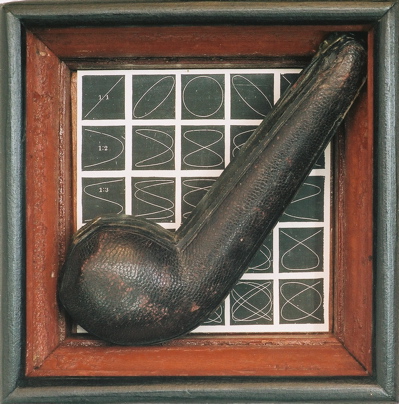 Johann Dieter Wassmann, HARMONISCH 1895. 145 x 145 x 70 mm.
Last week I focused on the composer Hugo Wassmann's involvement with the Guild of Funerary Violinists and the Mizler Society, a theme I don't want to leave just yet, so this week I thought I'd open by looking at the impact of music on Johann Dieter Wassmann's boxed works. Maime Stombock makes the point in her essay, "A Carpenter's Tale," that it was Johann’s friendship with the physicist Max Planck, and their mutual interest in the epistemology of music, that in many ways directed his thinking:
"The late night dialogues Johann records between himself and Planck more often than not centered around music. But then, he was a Leipziger: Wagner, Mendelssohn, Strauss, Liszt, Schumann, Brahms, Grieg, Mahler, they all spent crucial years in the city (as well as in Weimar) during the course of Johann’s life, allowing him to come in contact with each, as well as to see all but Wagner and Schumann either conduct or perform. It would be impossible to overstate the importance of music in his work, despite there being only a handful of direct musical references in his boxes.
"For Johann, music and only music could create such an idealization of space as to transcend time, while still existing within it as an undivided whole. Music is at once truth and form, knowledge and sensation. Music defies absolute space and time by not only transcending the boundaries, but by suggesting the very boundlessness of the universe itself.
"Another to have passed through Leipzig—in this case on his way to Vienna—was Sigmund Freud. In Freud, Johann found his journey had come full circle. Where Johann had begun by challenging his students to question the veracity of truth through his enigmatic displays on human physiology, he ended by proffering that truth is neither supreme nor absolute; our universe may be governed by laws, he suggests, but truth resides just outside our reach, amidst the deepest dark corners of a world we have only just begun to unravel: that of the human mind."
READ MORE
Friday, November 03, 2006
Saxony-Anhalt 1897
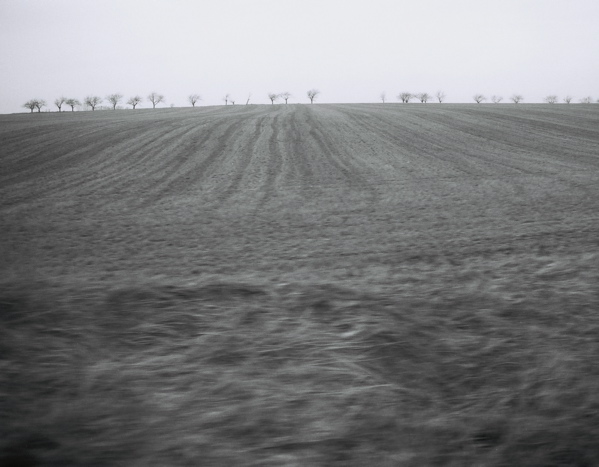 JOHANN DIETER WASSMANN, Saxony-Anhalt, 1897. Albumen silver print, 18 x 23 cm, WF 745003.
After a wordy and somewhat contentious week, I thought I'd end as I prefer to do on Fridays, leaving the picture to tell the story.
Tschüss
Thursday, November 02, 2006
Hugo Wassmann & The Mizler Society
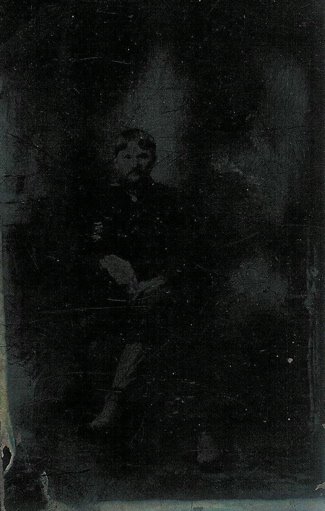 The recent release of Rohan Kriwaczek’s AN INCOMPLETE HISTORY OF THE ART OF FUNERARY VIOLIN has opened a pandora’s box of questions surrounding Hugo Wassmann’s involvement in the Guild of Funerary Violinists. No less puzzling, however, were Hugo’s ties to the Mizler Society. This late-Baroque musical society was founded by Loren Christoph Mizler von Kolof for the programmatic study of music’s innate relationship to science. Mizler, who attended the University of Leipzig and was a former student of Bach’s, devoted his master's thesis, “Quod musica ars sit pars eruditionis philosophicae,” to the development of a scientific approach to music grounded in mathematics and philosophy. Early members of the society included Bach, Handel and Telemann. Gatherings posed such troubling questions as why parallel fifths were undesirable.
Hugo Wassmann (Johann Dieter Wassmann's next elder brother, pictured dimly here in 1869) was introduced to the then-struggling Mizler Society while studying philosophy at the University of Leipzig. For reasons that are not well understood, Hugo remained a devotee to this antiquated, and decidedly anti-modern, society right up until his death in Weimar in 1915, at the age of 76.
A charming website examining the Mizler Society was recently launched by violinist John Rodgers, so turn up your speakers, click through and enjoy.
Wednesday, November 01, 2006
Hugo Wassmann & the Guild of Funerary Violinists
 Several correspondents across the Atlantic have, in recent days, raised queries over Hugo Wassmann’s falling out with the Guild of Funerary Violinists in 1901 (last Thursday's post). CRWM, writing on the blog AND NOW THE SCREAMING STARTS (link below) asks, “Did you not find it interesting that [Rohan Kriwaczek's] AN INCOMPLETE HISTORY failed to mention the irony that brother of one of the greatest proto-modernists was one of the last links to this most pre-modern of traditions?” Indeed, this fraternal relationship is a curious one, but I also find it telling that it was only after Johann’s death in 1898 that Hugo reconsidered his affiliation with the Guild.
 A letter from the noted Swedish music publishers Elin and Ulla Johnson, dated 5 December 1901 and addressed to Hugo, sheds some light on Hugo’s state of mind in coming to what must have been a wrenching decision (above). The letter is currently in the archives of The Wassmann Foundation, Washington, D.C. Although written in an old Swedish dialect, I will translate as best I can.
The letter opens thanking Hugo for a photograph (fotographi) he has recently sent them. They then go on to reassure Hugo he has made the right decision in leaving the Guild (def Gál), heartening him with the conviction that the saxophone will one day be the centrepiece of both orchestral and funerary composition, although not necessarily among Lutherans. The letter closes with this encouragement: “The burden is on your shoulders Hugo but God will provide.” It is signed on the reverse, “Elin & Ulla Johnson,” with the added remark, “…send Helge and Eva our love.” Helge and Eva were Hugo’s two surviving daughters.
I hope this sheds further light on the last remaining years of the Guild.
Tuesday, October 31, 2006
Not a spook, even on Hallowe'en
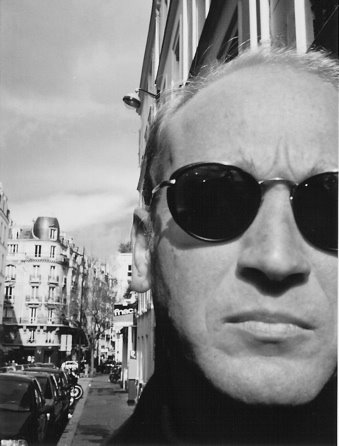 Must have been the champagne talking, not me; all the same, I do want to apologise to Wassmann Foundation director Jeff Wassmann for my wee hours post this morning inadvertently leaving open the possibility of Mr. Wassmann’s involvement with U.S. intelligence. He assures me unreservedly that his State Department stints in Beirut, Istanbul and Nairobi were all in the role of cultural attaché. Here’s our benefactor when we met in Paris a few weeks ago in an effort to finalise agreement for the repatriation to Germany of Johann Dieter Wassmann’s artwork after its 94-year absence.
Opening night at the Leipzig Film Festival
 Pictured: Countess Eva-Maria von Schönburg-Glauchau at Café Spizz.
Leipzig’s glitterati, and then some, gathered last night at the Museum der bildenden Künste for opening celebrations of the city’s annual film festival, Das Internationale Leipziger Festival für Dokumentar- und Animationsfilm, running until 5 November (see link below). Although a poor cousin to the Berlin Film Festival, in focusing on the genres of documentary and animation, the Leipzig festival has found its niche.
As the reluctant subject of THE FOUNDATION, a documentary film currently in production by Australian filmmaker Richard Moore, I’ve been busily booking out the festival season to see what I’m getting myself into.
The evening kicked off with a screening of three powerful films, most notably the short TOWER BAWHER by the Bulgarian digital animator Theodore Usher, who currently lives in Canada. Featuring the score “Time Forward” by Georgy Sviridov, the work sees Russian constructivism deconstructed by the 2nd law of thermodynamics, as entropy rules Usher's universe of line, volume, colour and form.
To the festival organisers' credit, more women directors than ever are represented, but the Eurocentric focus of the directors chosen (if not their subject matter) remains a disappointment.
The usual drinks and chatter followed, with a gracious welcome from mayor Burkhard Junj, before the crowd sprawled out into the chill in search of late-night venues on a sleepy Leipzig Monday. A few years beyond raving, I made my way with the international, but mostly European, contingent to Café Spizz, a local jazz club.
After a grilling over MuseumZeitraum’s American financial backing and a round of questioning over rumours of Wassmann Foundation director Jeff Wassmann’s intelligence connections (yes, I believe Mr. Wassmann was formerly with the U.S. Department of State and has some tie to the Kennedy clan; no, he isn’t a spook, to the best of my knowledge), the evening eased into the usual late-night banter covering the war in Iraq, Prof Dr Angela Dorothea Merkel, the sorry state of film funding and, of course, to what extent our Leipzig School painters have ‘gone Faust’.
With first light breaking and the birds a-chirping, I'll say good night for now and keep you posted as the week progresses.
Thursday, October 26, 2006
An Incomplete History of the Art of Funerary Violin
 A special thanks to Prairie Lights bookseller Jim Harris for sending along an advance copy of Rohan Kriwaczek’s AN INCOMPLETE HISTORY OF THE ART OF FUNERARY VIOLIN. As many of you may know along with Mr. Harris, Johann Dieter Wassmann’s brother, the composer Hugo Wassmann, was active in the Lutheran wing of Leipzig’s Guild of Funerary Violinists in the 1890s. Hugo’s ultimate falling out with the Guild came in 1901 over his efforts to introduce the saxophone to funerary rights, a practice that failed in Leipzig, but would eventually take hold in the city of New Orleans with great success, although not among Lutherans. Meanwhile, the art of funerary violin all but died out in Europe by 1915.
Here’s a short excerpt from the book’s dust-jacket, and a link if you’re interested in purchasing this intriguing work:
“During the Reformation a new musical form developed to replace Catholic funerary ritual. A solo violinist became central to the conduct of the Protestant funeral. Despite its enormous influence on classical music generally and on the Romantic Movement in particular, this music has almost entirely vanished. In a series of ‘funerary purges’, the violinists were driven into silence or clandestine activity.
“This is a music that, despite all attempts at suppression, has haunted Europe’s collective unconscious for more than a century. Now Rohan Kriwaczek reveals its incredible history. He acts in the hope that by remembering the Guild we realize afresh what our music once was, and what it might be once again.”
Wednesday, October 25, 2006
Wednesday Archive #6 - The birth of the modern
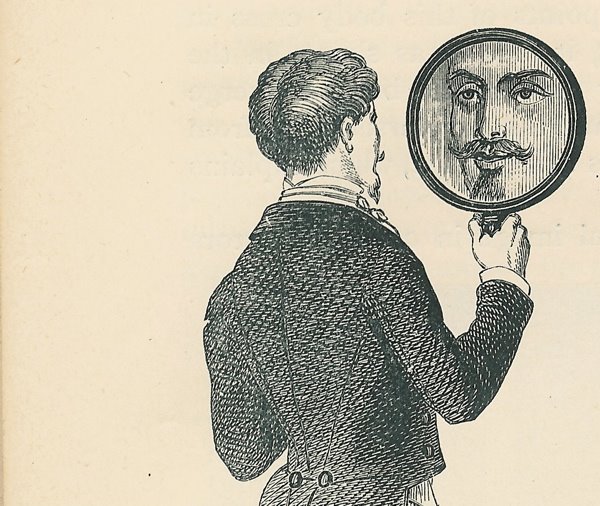
The general consensus among academics dates the development of an early modern aesthetic in Johann Dieter Wassmann’s work to 1889. Beyond the presence of modernist concerns in his assemblage works, and later photography, his awareness of the changing nature of art can clearly be seen in his collected ephemera, currently held in the archives of the Wassmann Foundation, Washington, D.C.
The idea that innate images and objects may store substantial metaphorical content is as old as art itself, but it was the modern era that saw their removal from historical context, with essence alone left to both represent and raise doubts about traditional linkages. Johann’s very process of gathering material, either for future works or purely for enjoyment, involved just such a process of removal, stripping away historical ties, opening up potential new meaning for a modern world.
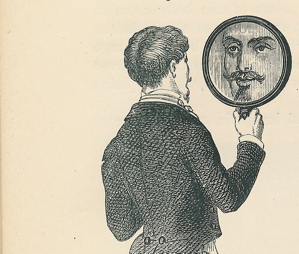
The engraving above is one such image, conjuring a wealth of surreptitious possibilities. Researchers at the foundation have since shown the engraving to be cut from E. Atkinson’s NATURAL PHILOSOPHY (London: Longmans, Green and Co., 1887), a translation of A. Ganot's COURS ÉLÉMENTAIRE DE PHYSIQUE, one of several editions Johann owned. The image is, however, nothing more than a demonstration of concave mirrors, but in clipping it from the surrounds of its purpose, he has liberated it, and the viewer, from the historicism of its creation.
Monday, October 23, 2006
Park Sanssouci 1897

JOHANN DIETER WASSMANN, Weinbergterrassen, Park Sanssouci, Potsdam, 1897. Albumen silver print, 18 x 23 cm, WF 748030.
As a native Berliner, the arrival of autumn has, since the fall of the wall, beckoned a short trip to Potsdam and a Saturday stroll through the delicious gardens of Sanssouci. This autumn proved no exception, a weekend in Berlin catching shows and openings providing the perfect opportunity to escape to the park’s wonderfully Rococo decadence. The 18th century summer residence of Frederick the Great, Sanssouci is more villa than palace, full of quiet moments of intimacy and folly.
Johann Dieter Wassmann was no less fond of making the trek, although never in summer. Autumn and early spring were his preferred seasons for taking in the brooding melancholy of this most cultured pearl.
Friday, October 20, 2006
The moons of Galileo
 "I should disclose and publish to the world the occasion of discovering and observing four Planets, never seen from the beginning of the world up to our own times, their positions, and the observations made during the last two months about their movements and their changes of magnitude; and I summon all astronomers to apply themselves to examine and determine their periodic times, which it has not been permitted me to achieve up to this day . . . On the 7th day of January in the present year, 1610, in the first hour of the following night, when I was viewing the constellations of the heavons through a telescope, the planet Jupiter presented itself to my view, and as I had prepared for myself a very excellent instrument, I noticed a circumstance which I had never been able to notice before, namely that three little stars, small but very bright, were near the planet; and although I believed them to belong to a number of the fixed stars, yet they made me somewhat wonder, because they seemed to be arranged exactly in a straight line, parallel to the ecliptic, and to be brighter than the rest of the stars, equal to them in magnitude . . .When on January 8th, led by some fatality, I turned again to look at the same part of the heavens, I found a very different state of things, for there were three little stars all west of Jupiter, and nearer together than on the previous night.
"I therefore concluded, and decided unhesitatingly, that there are three stars in the heavens moving about Jupiter, as Venus and Mercury around the Sun; which was at length established as clear as daylight by numerous other subsequent observations. These observations also established that there are not only three, but four, erratic sidereal bodies performing their revolutions around Jupiter."
Galileo Galilei, SIDEREUS NUNCIUS, March 1610.
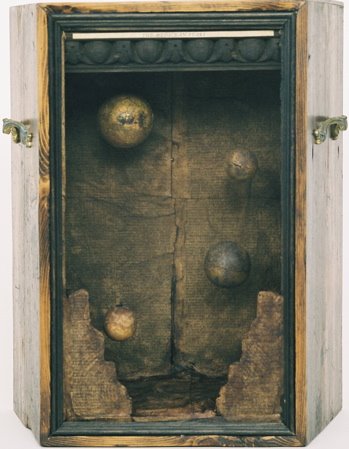
This week I’ve been looking at Johann Dieter Wassmann’s little-known 33-piece suite “Der Ring des Nibelunge,” 1896. Each work in this remarkable ensemble takes the form of a pine box, shaped as an isosceles trapezoid, with the glass front constituting the smaller of the two parallel planes. When assembled in three groups, 11 boxes are positioned to form a circle, with the fronts facing inward, toward one another, rather than outward toward the viewer.
The last of these three groups shows Johann’s strong fascination with an increasingly reductive notion of pure space, space nearing the void of deep space itself. In each of these boxes the sole structural element is one or more planetary forms, but rather than being highly descriptive, these elements are depicted as nothing more than aged brown balls, leaving the focus of our attention on the void itself. The inner surface of these boxes is lined with heavily-stained text, in the case of the work above text from a 19th century French-German dictionary. “The Moons of Galileo” is sufficiently descriptive to allow us to identify the individual moons – from top to bottom, Ganymede, Europa, Callisto and Io – but grouped alone, without Jupiter, they are purposely lost at sea.
This metaphor of complete and possibly abject isolation – the isolation not of the void, but of the individual within the void – came to dominate much of Johann’s output in the remaining 18 months of his life.
Thursday, October 19, 2006
The birth of the surreal
 As spring 1896 moved on to summer, Johann Dieter Wassmann continued work on his seminal 33-piece “Der Ring des Nibelunge” (Ring Cycle – please see my previous post for background). During this period the tone of the works turned increasingly playful, covering a range of interests, until a sudden shift arrived with autumn, his final 11 works in the series reaching a dark and deeply introspective spatial void, which I will discuss in my next post. Prior to the void, however, came “The Heavens”, shown above, in which a bird’s nest sprouts not baby birds, but five doll's legs in yet another nod to the Dadaists and Surrealists to come. As cheerful as it is perverse, it brings to mind the eerie 1930s constructions of Hans Bellmer.
Tuesday, October 17, 2006
Privilege of Priests
 Following on from my last post, “Of the Stealing of Women,” I thought it appropriate to introduce a companion piece Johann Dieter Wassmann also built in the spring of 1896. Titled “Privilege of Priests,” the construction again begins with an early 18th century law text, this time open to a case law page entitled, Privilege of Priests. But unlike “Of the Stealing of Women,” he removes it from its context, by a adding an engraving of a small boy bandaged from the same mid-19th century medical text as the bandaged women’s torso in “Of the Stealing of Women.” In doing so, the assemblage immediately and painfully evokes the broken children left behind by the unspoken and widely accepted practice of sexual abuse followed for centuries by the Catholic Church. While Johann could best be described as a lapsed Lutheran, we was adamantly anti-Catholic and more than willing to challenge the hypocrisy of the church in works such as this.
Both of these works are drawn from a suite of 33 similarly shaped pine boxes Johann called “Der Ring des Nibelunge,” so-named after Richard Wagner’s “Ring Cycle”. In Johann’s case, the 33 works are divided into 3 groups, with 11 boxes in each. These groups form perfect rings when installed with their glass front facing inward, so the works uniquely face and interact with one another, rather than outward toward the viewer. Johann purchased three round pine champagne tables in the summer of 1896 on which to display the works, but they were never publicly shown in his lifetime. Remarkably “Der Ring des Nibelunge” still has never been displayed as a complete group in a public institution, but will certainly be proudly on display when MuseumZeitraum Leipzig opens in July 2008.
Thursday, October 12, 2006
Of the Stealing of Women
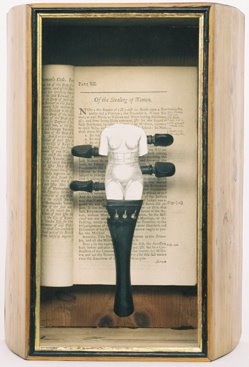 Dada and Surrealism were still years away when Johann Dieter Wassmann struck out with this monumental, if misunderstood, work, “Of the Stealing of Women” 1896. Never before published or exhibited, the work merges an early 18th century English case-law text, open to a page describing the (limited) rights of women from being, yes, that’s right, stolen, with a medical engraving of mid-19th century bandaging practices, all linked by a harmony of violin pegs and tailpiece. In his notes on the work, Johann enthusiastically describes the piece in terms that we now might read as empowerment and liberation, closing with an enigmatic quote from his beloved muse, Goethe: ‘Man sieht nur, was man weiss.’ One sees only what one knows. Some critics have hesitated at themes they (mis)read as bondage and repression, with one Australian curator going so far as to have the work removed from the exhibition BLEEDING NAPOLEON at the 2003 Melbourne International Arts Festival (see link below).
 Personally, I believe the work can be read as a nod to the rising sentiment across Europe in support of women's suffrage. Three years earlier, in 1893, New Zealand was the first country to introduce universal suffrage, generating headlines world-wide. The use of an English case-law book would suggest some reference to the British empire here. The image of a woman bandaged suggests a play on the word suffrage. Violin pegs are, of course, necessary to tune the instrument, implying an adjustment or refinement of the social politic to enhance the role of women in 19th century society.
Whatever its inner meaning, the work stands as a significant precursor to the explosive power Dada and Surrealism would have on the course of 20th century modernism.
Wednesday, October 04, 2006
The case of Mlle Marie-Madeleine Lafort Wednesday Archive #05
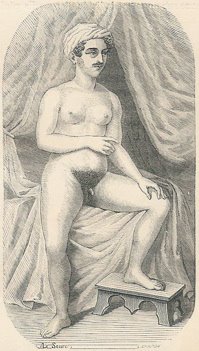 Amonst the many strange and wonderful dossiers gathered by Johann Dieter Wassmann is an extensive file he kept on the case of Mlle Marie-Madeleine Lafort, a French hermaphrodite whose physical peculiarities were widely studied and published in the mid-19th century (pictured at left in an 1872 engraving by L. Chapon from the collection of The Wassmann Foundation, Washington, D.C.) Johann's fascination was less voyeuristic than it might at first appear. In the 1890s he became intrigued with the growing debate concerning sexual identity and the determinants that come into play in making us male or female. The case of Mlle Lafort brought into doubt many of society's preconceived notions in this realm.
 The term hermaphrodite has its origins in Greek mythology, named after the son of Hermes and Aphrodite who became joined in one body with the nymph Salmacis. Now known as intersex, this condition of ambiguous genitalia is far more common than is generally assumed, with even the most conservative estimates putting the incidence at 1 in 4500 births. Until the 20th century, the condition was left as is, with parents free to raise the child as they saw fit, but with the rise of modern medicine the fate of the child to become a boy or a girl was most often determined surgically by doctors shortly after birth. For a more enlightened view on the condition and how best to consider the needs of the child, here's a link to Elizabeth Weil's recent piece "What if It’s (Sort of) a Boy and (Sort of) a Girl?" in The New York Times Magazine.
Subscribe to:
Posts (Atom)