Saturday, November 03, 2007
One last look
The announcement on Thursday that an agreement has been reached with the Wassmann Foundation that will see the works of Johann Dieter Wassmann repatriated to Germany has been met with overwhelming joy here in Leipzig (see official statement below). Before the works leave the United States, however, here's one last look at these beloved pieces in situ, as they have appeared for the last quarter century at the Wassmann Foundation's Washington, D.C. headquarters. Our tour is graciously led by Kaufmann Director Jeffrey D. Wassmann.


Thursday, November 01, 2007
Museum reaches landmark repatriation accord
FOR IMMEDIATE RELEASE
Washington, D.C., November 1, 2007 — Announcing a "new page of cooperation," MuseumZeitraum Leipzig and the Wassmann Foundation today signed a watershed accord under which the foundation will return over 100 nineteenth century assemblage works by the early modernist Johann Dieter Wassmann (1841-1898). For the past decade the artist’s Leipzig descendants have argued these works were removed in 1912 from storage in Weimar without their knowledge, consent or agreement.
In exchange for yielding the works to the Saxon museum — including the prized 33-work Der Ring des Nibelungen (Ring Cycle) 1895-1897 — the foundation will retain the artist’s large trove of photographic works and continue to oversee conservation. The foundation will also provide financial assistance for completion of a new home for the museum opening in July 2008.
At a joint news conference at the foundation’s Washington, D.C. headquarters, Kaufman Director Jeffrey D. Wassmann said the agreement "corrects the misunderstandings and errors committed in the past."
It will "pave the road to new legal and ethical norms for the future," he added. At the same time, Mr. Wassmann said, the accord "opens a new phase of collaboration which does not deprive the many visitors to our foundation of the opportunity to experience Johann’s legacy."
The pact, the first of its kind between an American foundation and a German museum, is being hailed as a model for settling repatriation disputes involving other Western arts institutions.
"Germany has won, the Wassmann Foundation hasn't lost, and what has benefited is culture," MuseumZeitraum’s director, Sophie Vogt, said at the signing ceremony.
Under the terms of the accord, the Wassmann Foundation will return a total of 115 works to Germany, among them Arteriae Pelvis, Abdomimis, et Pectoris, 1883, The Case of the City of London 1894, 16969, 1896, Vorworts! 1897, and the much-loved Nietzsche 306P 1897.
The works were shipped from Weimar to the Port of Baltimore in 1912 by the artist’s son-in-law, Edward Liszt, where they were taken into the care of Johann’s nephews, Friedrich, Dieter and Henry Wassmann. The works remained in storage, first in Washington, D.C. and later in Harrisburg, PA until 1969, when the foundation was established in the will of Gladys Wassmann. Since that time, the estate has been solely governed by the Wassmann Foundation, a role that will now be jointly shared by the two institutions.
Family members in Leipzig had long believed the works were destroyed in World War II, only becoming aware of their continued existence in the early 1990s after the reunification of Germany.
Of the works that will remain in Washington, Mr. Wassmann said, "The photographs of Johann Dieter Wassmann provide the missing link between the meticulous, but still largely prescriptive street imagery of mid-19th century photographer Charles Marville, and the lyrical melancholy of Eugene Atget in the early 20th century. As a predecessor to his fellow countrymen Heinrich Zille and August Sander, Johann discreetly anticipated what vast potential the photographic arts held for the modernist era."
Ms. Vogt commented that, “The restitution of the works represents the healing of a wound. We are grateful to the Wassmann Foundation for safekeeping and conserving these works, but it is now time for them to come home.”
"This is another step forward," she said of the agreement. "But Leipzig must also hold up its own end by seeing that the doors of MuseumZeitraum open wide in July 2008 to Johann’s many passionate admirers on both sides of the Atlantic.”
Washington, D.C., November 1, 2007 — Announcing a "new page of cooperation," MuseumZeitraum Leipzig and the Wassmann Foundation today signed a watershed accord under which the foundation will return over 100 nineteenth century assemblage works by the early modernist Johann Dieter Wassmann (1841-1898). For the past decade the artist’s Leipzig descendants have argued these works were removed in 1912 from storage in Weimar without their knowledge, consent or agreement.
In exchange for yielding the works to the Saxon museum — including the prized 33-work Der Ring des Nibelungen (Ring Cycle) 1895-1897 — the foundation will retain the artist’s large trove of photographic works and continue to oversee conservation. The foundation will also provide financial assistance for completion of a new home for the museum opening in July 2008.
At a joint news conference at the foundation’s Washington, D.C. headquarters, Kaufman Director Jeffrey D. Wassmann said the agreement "corrects the misunderstandings and errors committed in the past."
It will "pave the road to new legal and ethical norms for the future," he added. At the same time, Mr. Wassmann said, the accord "opens a new phase of collaboration which does not deprive the many visitors to our foundation of the opportunity to experience Johann’s legacy."
The pact, the first of its kind between an American foundation and a German museum, is being hailed as a model for settling repatriation disputes involving other Western arts institutions.
"Germany has won, the Wassmann Foundation hasn't lost, and what has benefited is culture," MuseumZeitraum’s director, Sophie Vogt, said at the signing ceremony.
Under the terms of the accord, the Wassmann Foundation will return a total of 115 works to Germany, among them Arteriae Pelvis, Abdomimis, et Pectoris, 1883, The Case of the City of London 1894, 16969, 1896, Vorworts! 1897, and the much-loved Nietzsche 306P 1897.
The works were shipped from Weimar to the Port of Baltimore in 1912 by the artist’s son-in-law, Edward Liszt, where they were taken into the care of Johann’s nephews, Friedrich, Dieter and Henry Wassmann. The works remained in storage, first in Washington, D.C. and later in Harrisburg, PA until 1969, when the foundation was established in the will of Gladys Wassmann. Since that time, the estate has been solely governed by the Wassmann Foundation, a role that will now be jointly shared by the two institutions.
Family members in Leipzig had long believed the works were destroyed in World War II, only becoming aware of their continued existence in the early 1990s after the reunification of Germany.
Of the works that will remain in Washington, Mr. Wassmann said, "The photographs of Johann Dieter Wassmann provide the missing link between the meticulous, but still largely prescriptive street imagery of mid-19th century photographer Charles Marville, and the lyrical melancholy of Eugene Atget in the early 20th century. As a predecessor to his fellow countrymen Heinrich Zille and August Sander, Johann discreetly anticipated what vast potential the photographic arts held for the modernist era."
Ms. Vogt commented that, “The restitution of the works represents the healing of a wound. We are grateful to the Wassmann Foundation for safekeeping and conserving these works, but it is now time for them to come home.”
"This is another step forward," she said of the agreement. "But Leipzig must also hold up its own end by seeing that the doors of MuseumZeitraum open wide in July 2008 to Johann’s many passionate admirers on both sides of the Atlantic.”
Tuesday, October 30, 2007
MuseumZeitraum Leipzig

After travels and travails more varied than I'd care to mention, the MuseumZeitraum Leipzig blog returns this week with news, views and all the rest from Leipzig and beyond. Stayed tuned... we're back!
Wednesday, July 18, 2007
Is modernity our antiquity?
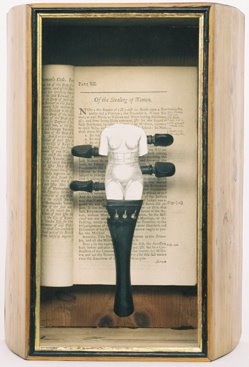 Dada and Surrealism were still years away when Johann Dieter Wassmann struck out with this monumental, if misunderstood, work, “Of the Stealing of Women” 1896. Never before published or exhibited, the work merges an early 18th century English case-law text, open to a page describing the (limited) rights of women from being, yes, that’s right, stolen, with a medical engraving of mid-19th century bandaging practices, all linked by a harmony of violin pegs and tailpiece. In his notes on the work, Johann enthusiastically describes the piece in terms that we now might read as empowerment and liberation, closing with an enigmatic quote from his beloved muse, Goethe: ‘Man sieht nur, was man weiss.’ One sees only what one knows. Some critics have hesitated at themes they (mis)read as bondage and repression, with one Australian curator going so far as to have the work removed from the exhibition BLEEDING NAPOLEON at the 2003 Melbourne International Arts Festival.
 Personally, I believe the work can be read as a nod to the rising sentiment across Europe in support of women's suffrage. Three years earlier, in 1893, New Zealand was the first country to introduce universal suffrage, generating headlines world-wide. The use of an English case-law book would suggest some reference to the British empire here. The image of a woman bandaged suggests a play on the word suffrage. Violin pegs are, of course, necessary to tune the instrument, implying an adjustment or refinement of the social politic to enhance the role of women in 19th century society.
Whatever its inner meaning, the work stands as a significant precursor to the explosive power Dada and Surrealism would have on the course of 20th century modernism.
Sunday, July 08, 2007
Is modernity our antiquity? What is bare life?
 Johann Dieter Wassmann, Nietzsche 306P, 1897. 370 x 280 x 100 mm.
In recent posts I've been examining the first of three leitmotifs posed by the Documenta 12 team, "Is modernity our antiquity?" If I may, I'd like to skip ahead to the second question for a moment, "What is bare life?" as further means of addressing the first.
In 1889, Friedrich Nietzsche suffered a mental breakdown, often attributed to his contraction of syphilis, resulting in his admission to various clinics before he was moved to Naumburg, where his mother looked after him until her death in 1897. At this point his sister Elisabeth shifted him to Weimar, where she continued his care, as well as promoting his legacy and allowing the occasional audience with guests until his death in 1900.
It was in Weimar that Johann Dieter Wassmann briefly visited Nietzsche, but finding only a shell of a man he returned home to produce this work, depicting simply and eloquently the empty collar of the man, an organ stop with the name 'Nietzsche' printed on it, and an opium-stained bone apothecary spoon; a life stripped bare. These objects are placed against a dappled blue wall, reflecting Nietzsche's penchant for blue-lensed spectacles.
Johann's ability to take the contemporary moment of his visit with Nietzsche and so confidently convert it into the iconography of modernism speaks legions about the raw vitality of the modern movement at the dawn of the 20th century. In no time, however, modernity fell victim to the second law of thermodynamics, with entropy holding sway, but it was not until the close of the century that we realised the paradigm had simply collapsed en route.
Today it is essentially modernity stripped bare that we address as artists and curators, an ongoing post-mortem of abject failure. So in this sense is modernity our antiquity? The answer is not so clear.
Wednesday, June 27, 2007
Documenta 12 takes a beating.
 After being savaged by the English-language press earlier in the month, Documenta 12 has now been ravaged by the elements, with Ai Weiwei's Template collapsing in high winds last week. In more recent days, the Plastic Palace has failed to keep Kassel's heavy rains out with roof vents found to be faulty and refusing to close (although we are happy to report there have been no fatalities of either art or art lovers, excluding Template, that is). On low land near the river, the Aue Pavilion is fast becoming the Eau Pavilion, so bring your Wellington boots if you're planning to visit anytime soon. With 90 days to go, let's hope the rest holds together for late arrivals.
 Is modernity our antiquity? Well, the ruins of Documenta 12 would certainly suggest as much.
.jpg)
Tuesday, June 26, 2007
The Zeitraum gardens
 Work continues at MuseumZeitraum Leipzig toward our mission of opening to the public next summer. This week the foundations went in for our garden terrace. The terrace is a tribute to one of Johann's best known works, his photograph of the Freundschaftstempel in Potsdam, 1896 (below).
 Frederick the Great had this small, elegant temple built in 1768 in memory of his sister, Wilhemine of Bayreuth by Gontard, according to his own sketches and plans. It was modelled on the Temple of Apollo in the Amalthea garden at Neuruppin, court architect Georg Wenzeslaus von Knobelsdorff's first work.
Is modernity our antiquity? Hmmm... the lines blur!
 JOHANN DIETER WASSMANN, Freundschaftstempel, Potsdam, 1896. Albumen silver print, 18 x 23 cm, WF 743020.
Sunday, June 17, 2007
Is modernity our antiquity?
 Earlier this evening I was delighted to bump into curator Abigail von Bibera at Documenta 12's Museum Fridericianum. Over drinks she made the observation that the creative process behind Hazoume Romould's African 'masks'(see below) struck her as remarkably similar to the thinking that must have gone into Johann Dieter Wassmann's Prince Otto von Bismarck, 1896, pictured here. Good spot Abigail. Which again raises the question, is modernity our antiquity? Or as I discussed in an earlier blog, is it just our Hotel California?
Saturday, June 16, 2007
First Look: Hazoume Romuald @ Documenta 12


 Is modernity our antiquity? Hazoume Romuald proffers an answer.
The morning after the night before.
 With revelers still wandering the streets of Kassel from the opening party last night, Documenta 12 is just a few hours away from officially opening to the public. Here's a photo op from earlier in the week of the artists selected for this year's event. I've uploaded a fairly large file, so click on it to enlarge if you want to better see who's who. While I managed a sneak preview of several venues yesterday, Walter Robinson has written quite a comprehensive piece for ArtNet so click through for his first impressions and I'll fill you in with more in the coming days.
Thursday, June 14, 2007
Is modernity our antiquity? The answer is nigh.
 Documenta 12 doesn't officially open till the weekend, but a number of works have been erected in public spaces here in Kassel and they're already drawing interest from locals and early arrivals. This afternoon I ran out to have a look at Shipwreck and Workers (version 3) (pictured) by Allan Sekula at the Herkules (mentioned in my last post). The work comprises a progression of large photograghs, several of which can be seen here to right of the Wasserspiel. Sekula hails from Erie, PA and was also heavily featured in Documenta 11.
 Unfortunately, the rain that plagued the opening days of the Venice Biennale seems to have followed the art mob north and moments ago began bucketing down in droves as I waited for my tram back into town from Schloss Wilhelmshöhe. With more of the same forecast throughout the weekend, let's hope King Roger's Plastic Palace isn't made of cotton candy.
Blackberry permitting, I'll duly keep you posted. Tschüss.
Tuesday, June 12, 2007
1 down, 2 to go.
 As the art hoards head north from Venice to Basel this week, the citizens of Kassel are enjoying one last moment of calm before the onslaught begins on their own city, with the opening of Documenta 12 this weekend.
 Several readers have asked advice on what else there is to do in Kassel beyond Documenta, with the standard reply being, "Nothing," but I beg to differ. Kassel's museums offer a cabinet of curiosities well worth pursuing when you need a break from the newest and latest at Documenta. While The German Wallpaper Museum may not be to everyone's liking, the home of the Brothers Grimm is a short walk from main Documenta venues, offering a welcome respite. Across the street from the Grimms is the Neue Gallery, featuring perhaps Joseph Beuys best known work, The Pack, 1969 (above), as well as many landmark German paintings from the late 20th century.
Even closer to Documenta is the rather fabulous Museum of Natural History in the Ottoneum. You'll pass it daily walking from the Museum Fridericianum to L'Orangerie, but few of Document's 650,000 viewers will ever step into this marvelous little museum of wonders.
Also worth a diversion is Schloss Wilhelmshöhe on the edge of town, which houses the Old Masters Gallery. Choose a Wednesday or Sunday and you'll experience one of the great marvels of eighteenth century mechanical engineering, as you watch the Wasserspiel cascade down the mountain in it's half hour trek from the Herkules statue on the summit, finishing in a 52 meter jet of water in the gardens of the Schloss.
Unlike Venice and Basel, opening night in Kassel is a public event, with a grand party for the entire city kicking off Friday night.
Is modernity our antiquity? Finally, we'll learn the truth according to Roger & Ruth this weekend. See you there.
Monday, May 21, 2007
Zeitraum Rising
 I've just realised I haven't given you an update on MusesumZeitraum's progress in some time. Too busy debating the great issues. Here's a shot of Klaus Richter in the Leipzig foundry where our fabulous new staircase is being fabricated. When installed, this sculptural wonder will lead up from the ground floor galleries to the photographic rooms.
 Is modernity our antiquity? Not at MuseumZeitraum, where modernity remains the order of the day.
Wednesday, May 16, 2007
When men were men and Beuys was Beuys. Documenta 12 enjoys the shade of D7.
 With the opening of Documenta 12 just a month away, I ventured out west to Kassel last week to visit King Roger and Queen Ruth and gaze upon their majestic new Plastic Palace on the grounds of L’Orangerie. If you don’t mind the distant roar of generators and compressors keeping the air conditioning flowing, and you ignore the implications for Documenta 12’s carbon footprint, it’s a spectacular sight, even without the art installed.
It is not possible in my experience, however, to visit Kassel without feeling the overwhelming presence of an installation that returns to life this time every year, that of Joseph Beuys 7000 Eichen (7000 Oaks). Planting of the trees began at Documenta 7 in 1982 and continued for five years with support from the Dia Foundation, with the last of the 7000 planted at D8.
25 years on, the oaks are reaching a more graceful maturity than most of us. And hopefully, with the buds open and the leaves growing to fullness this month, Prince Joseph’s grand gesture will be busy converting King Roger’s carbon dioxide output back into fresh clean oxygen.
One of my favourite gifts for artist friends is to pass along a handful of acorns from these sacred oaks after a trip to Kassel. I’ve even been known to hop off the train to spend an hour collecting acorns before jumping on the next train when my travels take me through Kassel. This year I loaded up a shoe-box full from around the University and have been busy wrapping them up and posting them out. The notion of the artist’s seed spreading across the globe even after death is terribly modernist, I know, but all credit to Prince Joseph for such a far-sighted effort.
Is modernity our antiquity? In this case, sadly yes. What is bare life? Prince Joseph’s seed – the acorn – I believe. Was tun? Plant trees, King Roger, to repent for your sins!


Wednesday, April 25, 2007
"Controversy is normal with us"
 Documenta 12 artistic director Roger M. Buergel offers members of the press a guided tour of exhibition venues earlier today in Kassel.
 Buergel made clear he has won the argument with architect Jean Philippe Vassal that I've been reporting on in recent days and the Plastic Palace will be fully air conditioned. Roger pointedly told the press, "The architecture has to subordinate itself to the art." As to such high-brow concerns as his leitmotif, Is modernity our antiquity? we'll get back to that after the gossip dies downs.
Tuesday, April 24, 2007
Documenta 12: better pack your Hawaiian Tropic
 Last week I gave you a first look at the new Plastic Pavilion rising before Kassel’s Orangerie for Documenta 12 this summer. This week I can confirm rumours circulating around the city that artistic director Roger Buergel isn’t altogether happy with the pavilion's architects, Jean-Philippe Vassal and Anne Lacaton.
 Die Süddeutsche Zeitung is running an interview with the French team today in which they take the position that the structures should live and breathe Kassel's natural climate. Roger's not so sure.
"The problem is not the form of the pavilion," explains Vassal. "It's the system. One should feel the atmosphere of fresh air in the [Karlsaue] park, close to the river. In the summer, the Karlsaue should become a resting place that is as natural as possible and understood as part of the exterior. The climate should be felt inside, too, in a way that's different from the traditional museum. . . A greenhouse should not be sealed off."
Buergel, on the other hand is panicking that hanging art works -- many on loan from institutional collections -- in a hot and sweaty greenhouse all summer may not make him the most popular director among conservation staff. Word has it there are already threats of works being pulled from the show.
The architects argue the system meets Buergel's concept of an India-inspired "palm grove" where guests can congregate and discuss art and society, while Buergel is insisting his metaphor is being taken a little too far.
"The most important factor for the museum climate is the sweat of each individual visitor," Vassal says. "There, a purely artificial atmosphere becomes a problem. If Buergel has an image in mind of people sitting under trees in India, then he should think about what kind of architecture comes closest to this image."
Is modernity our antiquity, Roger asks? It will be soon enough if he starts shipping home Ruschas and Richters left faded, blistered and cracking from a summer in the sun.
Monday, April 23, 2007
Was tun? A way forward.
Over the past two months I've been deliberating Documenta 12's leitmotif, Is modernity our antiquity? I've argued that both modernity and antiquity are little more than linear, if substantial, events in the West's ongoing Terror of History. This terror has now engulfed all the world's reaches, but there are those still defiant in their determination not to sink into the cultural morass that is the West's making. I offered the example of Aboriginal Australia, one culture whose preoccupation with place has allowed them to maintain a certain remove from this Terror of History and from the all-consuming linearity of time.
A performance staged last month at the National Gallery of Victoria in Melbourne, offers perhaps the most compelling way forward, one involving neither modernity, nor antiquity, but an acceptance of the Aboriginal world-view transcendent of time, fixated rather on the universality of space. Here several of Australia's leading jazz musicians perform traditional manikay (song) with songmen from the Ngukurr community, along the Roper River in south-east Arnhem Land. In singing the songs of their ancestors, songs whose origins anthropologists date back some 40,000 years, these songmen and their jazz cohorts join together to renew the very birth of our human existence, a humbling and thought-provoking thing to experience, even if only on YouTube.
Wednesday, April 18, 2007
Documenta 12 wonders, is modernity our antiquity? Yes, and we have Andy and GoogleNation to thank.
Regular readers will notice several changes in our blog over the past week, with the inclusion in our right-hand column of a live news diary covering breaking events in the art world, and rotating videos relating to both Leipzig and the art scene at large. These are brought to you courtesy of Google and YouTube. The news pre-set is for stories on documenta 12, but you can click on any of the other listed keywords, including biennale, louvre and museumzeitraum to find out what's happening in these worlds.
In the lead-up to Documenta this summer, we've been discussing Roger and Ruth's leitmotifs, is modernity our antiquity?, what is bare life? and was tun?
One of my contentions has been that the breakdown of modernity has come about through the collapse of its power structures, mostly recently and most significantly through the rise of the internet. Constantly evolving technologies such as these services all contribute to an increase in the reach and voice of the individual at the expense the traditional gatekeepers of the canon, creating a certain paradox: in a mass global society, the power and importance of the individual grows, rather than diminishes. For individuals in what were formerly the planets outer reaches, the web has democratised access to the structures and machinations of power to an extent previously unimagined. Little more than 20 years after the art world 'discovered' there was an 'outside' and 'periphery', they've suddenly found it's gone. With the playing field flattened in our postcolonial/internet age, there is only the centre to be fought over and for the artist, the ensuing chaos to decipher. Where once the internet merely informed the political process, it now has the immense capability of wholly transforming it.
Thursday, April 12, 2007
Documenta 12 rises before the Orangerie
 With all our talk of Documenta 12's leitmotifs in recent weeks - Is modernity our antiquity? What is bare life? Was tun? - it's easy to forget there's real work being done to ready Kassel for the grand opening, just two months away. Here's a first look at the temporary galleries, or Plastic Palace as it's being called, on the beautiful grounds of the Orangerie.
Wednesday, April 11, 2007
Documenta 12 asks, “Is modernity our antiquity?” MZL wonders, maybe it’s rocket science after all.
 Three years after the publication of Albert Einstein’s seminal Special Theory of Relativity (1905), his mentor and one-time teacher, Hermann Minkowski, gave a lecture in Cologne elaborating on his former student’s findings, beginning with the proclamation that,
 Henceforth space by itself, and time by itself, are doomed to fade away into mere shadows, and only a kind of union of the two will preserve an independent reality.
What Minkowski couldn’t predict was how painfully long it would take for our Newtonian belief in fixed time to actually fade into mere shadows. As the twentieth century unfolded, fixed time only became more entrenched, largely because it proved so useful a tool in promoting our singular march toward Progress.
As I’ve discussed in previous posts, there are cultures for whom space and time never suffered the humiliation of separation, Aboriginal Australia chief among them. Here the Dreaming maintains a union of the two, where there is only place to consider.
Einstein would seem to concur, once stating, “The distinction between past, present and future is only an illusion, even if a stubborn one.” To remove Einstein’s theory from the theoretical and prove it, of course, meant doing things like sending a twenty-year-old identical twin off in a rocket at very nearly the speed of light for two years (in his time), and have him return to find his brother a very old man living comfortably in Tucson, Arizona with the rest of the feeble old scientists who had shot him off into the ether seventy years earlier (in their time) in the first place.
The truth that rested in his theory of relativity also provided the unwanted proof of what an oily calm modern man had been sailing headlong into, somewhere en route ordaining the rest of the world should run adrift with him.
Despite the lingering influence of those such as Heidegger — with his modified Newtonian view of the present — it should have been apparent that in a world of space-time, the past, the present and the future all do exist quite simultaneously.
What modern man failed to realise Einstein was saying, was that time and space aren’t fixed or readily determinable; they are, in fact, infinitely variable. And while they do exist in a relative sense, there is nothing absolute in their nature. They are instead interwoven, making one quite inseparable from the other. So time exists for me in the space I occupy, and time exists for you in the space you occupy, but there are no grounds for the worn-out belief that time exists commonly and universally for the both of us.
That which modern man has known and thought of as time for so long is certainly no less real than the printing press or the motor car, but nor is it any less a product of his own invention.
Returning to Roger and Ruth’s question, “Is modernity our antiquity?” then, in terms of the world-view they perpetuate they could just as well be one in same. The failed linearity of time is inherent and intrinsic to both.
Subscribe to:
Posts (Atom)