Tuesday, August 18, 2009

Goodbye Neo. Goodbye Leipzig.

Replacing Neo Rauch as a professor is not going as smoothly as one might have hoped here at Leipzig’s Academy Hochschule für Grafik und Buchkunst. As Die Tageszeitung’s Robert Schimke reports, the Cologne painter Heribert C. Ottersbach has been selected as the successor to Rauch after the international star of the Leipzig School decided to give up his professorship, due to his workload. According to Schimke, Rauch had his own favorite replacement: the Belgian artist Michaël Borremans. Yet Borremans fell through the hiring process because he does not speak German well and lives too far away from the academy.

After convincing Borremans—both a painter and a filmmaker—to apply for the Leipzig position, Rauch reportedly believed that the artist’s twin specializations would be a nod to a portion of the faculty that has no warm feelings for the traditional Leipzig school of painting, including the academy’s rector Joachim Brohm. While Brohm insists that he was not involved in the hiring process, it doesn’t help matters that Ottersbach is a friend of Brohm and one of three painting professors who come from the Brohm’s Rhineland home in western Germany.

“Already in the past,” writes Schimke, “the rector had earned the reputation of taking his network into the Leipzig professorships.” Schimke doesn’t believe that the conflict represents a mere East-West career skirmish but rather a “cultural clash,” which began as a formalist debate in the 1950s in former East Germany and in the vilifications between state-branded German Democratic Republic painters and liberal-minded painters from the West.

Another antagonism lies in the marginalization throughout the 1990s of the Leipzig painters by new media art and more discursive artistic practices. Schimke speculates that Brohm—a photographer socialized by the arts scene in the Rhine region during the ’70s and ’80s—might just be quickening the end of the Leipzig School.

Monday, June 01, 2009

Daniel Birnbaum on "Making Worlds/Fare Mondi"


La Biennale di Venezia
Making Worlds/Fare Mondi
The 53rd International Art Exhibition
Director: Daniel Birnbaum
7 June 2009 – 22 November 2009

Sunday, May 24, 2009

Fare Mondi // Making Worlds // Bantin Duniyan // 制造世界 // Weltenmachen // Construire des Mondes // Fazer Mundos…


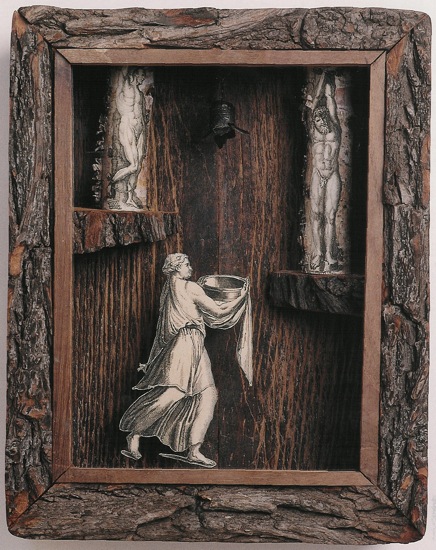
Johann Dieter Wassmann, Et in Arcadia Ego, 1887. 20 x 16 x 12 cm.

In posts over the past several months, I’ve been looking at the terror and anxiety of history through the melancholy of Daniel Birnbaum’s 50 moons of Saturn for the Turin Triennale and more recently his soon-to-open Fare Mondi/Making Worlds for the Venice Biennale. By the 1880s, Johann Dieter Wassmann similarly found himself troubled by a deep melancholy, one which he responded to initially by retreating into the romantic past of his forefathers, a response having clear relevance today. But soon he entered into and created for himself a wholly new world, a world of modernist sensibilities leading to some of the most pioneering work of the late 19th century. From here, I’ll hand it over to Maime Stombock, quoting from her seminal essay, A Carpenter’s Tale:


“Despite his considerable achievements, Johann felt increasingly troubled as the century hastened toward its close... His suspicion that the deliberate progress of modernity was fast bearing down overwhelmed him with regular fits of fear and uncertainty. When he first caught sight of this brooding monolith his response was to back-pedal his way out of the 19th century and into his romanticized view of an earlier, less pressured era. As he came to feel more at ease with the medium of the wooden box he staged his retreat by venturing into works that he hoped might help him to combat this anguish. Here his creative impulse was most Germanic: a return to the ancient wood, with Goethe looming large, although his influences were equally eclectic. His great love of the American Transcendentalist authors Ralph Waldo Emerson and Henry David Thoreau is apparent in several works. He had grown fond of their writings while living in Washington, D.C., where he consulted on a long overdue sewerage system for the nation’s capitol during Restoration—the first in the world to be built of concrete, a pioneering design solution born of necessity amid the poorly-drained swamplands of the Potomac.

"Whether conscious or not, his impulse to celebrate the ancient wood twenty years later can be read as an unsurprising response to the soulless concrete, brick and mortar that dominated his professional life. Johann had long found solace in the wood, a passion so deeply imbedded in the German psyche it was the subject of the Roman historian Cornelius Tacitus’ classic Germania; or, On the Origin and situation of the Germans, recorded in the year 98. For Roman readers, Germania served to explain why these primitive arcadians were such barbarians. For the Germans themselves, Tacitus’ portrayal of them as little more than arboreal hunters, gatherers and warriors was taken as a compliment. Germania eventually became a raw staple in their literary diet, all the more so after the first native translation was published in Leipzig in 1496.

“For Johann, delving into the ancient wood was an essential catharsis, just as it would be a hundred years later for his compatriot Anselm Kiefer. In a letter to his brother Wolfgang, dated November 10, 1885, Johann writes that from the moment his saw broke the grain of his rough planks of birch, oak, pine, beech, ash, walnut, elm or whatever else might be at hand, he was magically propelled through the looking glass, moving into the wood, first physically—as he cut, planed, joined and finished the timbers—and then mentally—as he deliberated what world might inhabit the inner space of these exquisite boxes.

“His experience of the wood spared none of the senses, however. The sweet freshness of pine, the acrid harshness of elm that burned the eyes and throat, the gentle pleasantries of oak: he genuinely believed as his father had that the souls of men inhabited these timbers and only by cutting into them and experiencing them fully could these souls find release. He reminded Wolfgang of the stories their father would tell them as children, the stories they would insist on hearing again and again of the family workshop in the years that followed the Battle of Leipzig, a time when their father himself was just a child. The terrible destruction of the city and surrounding villages had left such an abundance of floorboards, panelling and structural timbers that Leipzig’s woodcutters found no cause to fell a single tree for three years, instead harvesting their bounty from the rubble. But unlike fresh cut timbers, which house only old souls, August commanded to his sons that recycled timbers uniquely house the souls of those more recently departed.

“The oak parquetry of Madame Troufold’s salon, gracefully planed and mitered by their grandfather to make a small corner cupboard, had overwhelmed the workshop for a week with the perfumed elegance of a life cultured beyond their dreams. The softly worn pine floorboards of Herr Zächer’s bäckerie, despite being scrubbed with bucket and brush each morning, had brought such hunger to the journeymen when they cut into them to frame the carcass of a veneered chest of drawers that they finished their daily bread before noon, venturing out to find more before returning to their work. The walnut panelling recovered from Kapitän Brunheld’s library, the walnut that their grandfather fashioned into several fine wardrobes, had surrendered thick smoky tobacco, aged whiskey and a thousand tales of Saxon glory before the wardrobes left the shop. And the narrow ash planks from the stairway of Fräulein Nau’s bordell, the planks their grandfather had hoped to shape into dough bins, brought work to such a halt and lowered the integrity of the conversation to such a degree that he gave up in disgust, burning them as firewood, although the smoke from the fire provoked one of the men to partake in a debaucherous drinking binge lasting three days, ending with his arrest for committing unnatural acts in the public square.

“Wolfgang’s reply to his letter was that old men tell tall tales, so leave it at that, but Johann was undeterred, at least for the moment. While this period was both cathartic and crucial in defining the roots of Johann’s dissatisfaction, and while his output might seem to us today to be quite charming, within the decade he too would come to question the romantic overtones in his response.”


La Biennale di Venezia
Making Worlds
The 53rd International Art Exhibition
Director: Daniel Birnbaum
7 June 2009 – 22 November 2009

Sunday, April 12, 2009

Easter in Leipzig

Johann Dieter Wassmann, Nikolaikirche, Leipzig, 1894, 18 x 23 cm.

Tuesday, March 24, 2009

Artists announced for Venice Biennale


Venice, 23rd March 2009 (press release)

The 53rd International Art Exhibition, entitled Fare Mondi // Making Worlds // Bantin Duniyan // 制造世界 // Weltenmachen // Construire des Mondes // Fazer Mundos…, directed by Daniel Birnbaum (pictured), organized by La Biennale di Venezia chaired by Paolo Baratta, will open to the public from Sunday June, 7th to Sunday November, 22nd 2009 in the Giardini (50,000 sq.m.) and the Arsenale (38,000 sq.m.) as well as in various other locations around the city. The press preview will take place on June 4th, 5th, and 6th 2009.

The Director of the 53rd Exhibition, Daniel Birnbaum, has been Rector of the Staedelschule Frankfurt/Main and its Kunsthalle Portikus since 2001. Fare Mondi // Making Worlds, presented in the renewed Palazzo delle Esposizioni in the Giardini and in the Arsenale, is a single, large exhibition that articulates different themes woven into one whole. It is not divided into sections. Considering collectives, it comprises works by over 90 artists from all over the world and includes many new works and on-site commissions in all disciplines.

“The title of the exhibition, Fare Mondi // Making Worlds,” says Director Daniel Birnbaum, “expresses my wish to emphasize the process of creation. A work of art represents a vision of the world and if taken seriously it can be seen as a way of making a world. The strength of the vision is not dependent on the kind or complexity of the tools brought into play. Hence all forms of artistic expression are present: installation art, video and film, sculpture, performance, painting and drawing, and a live parade. Taking 'worldmaking' as a starting point, also allows the exhibition to highlight the fundamental importance of certain key artists for the creativity of successive generations, just as much as exploring new spaces for art to unfold outside the institutional context and beyond the expectations of the art market. Fare Mondi // Making Worlds is an exhibition driven by the aspiration to explore worlds around us as well as worlds ahead. It is about possible new beginnings—this is what I would like to share with the visitors of the Biennale.”

For the direction of the exhibition Daniel Birnbaum is supported by Jochen Volz, artistic organization. Additional advice is provided by an international team of correspondents consisting of Savita Apte, Tom Eccles, Hu Fang, and Maria Finders.

On the occasion of the 53rd International Art Exhibition – the Venice Biennale Foundation inaugurates a number of important structural and organisational developments:

At the Arsenale, the Italian Pavilion has been enlarged from 800 to 1,800 square meters, now opening out to the Giardino delle Vergini and adjacent to a new public entrance. Here a newly constructed bridge links the far side of the Arsenale to the Sestiere di Castello. This renewed Italian Pavilion will be reserved for exhibitions organised by the Italian Ministry for Cultural Affairs. The Italian participation at the 53rd International Art Exhibition is curated by Beatrice Buscaroli and Luca Beatrice. Furthermore, the Arsenale’s exhibition spaces have been extended by developing a larger part of the Giardino delle Vergini (Garden of the Virgins), now measuring 6,000 square meters and offering an enchanting new exhibition space for the main exhibition.

In the Giardini, the historic Italian Pavilion has been renamed Palazzo delle Esposizioni della Biennale and extensively transformed, now providing a permanent exhibition and multi-functional venue opened to the public throughout the year. The transformed Palazzo delle Esposizioni includes a newly refurbished wing housing the library of the Historic Archives of Contemporary Arts (ASAC), made available again to the public after ten years of closure. The Archive comprises documents, books, catalogues and periodicals, freely consultable by researchers and exhibition visitors. Apart from exhibition spaces, the Palazzo delle Esposizioni also comprises a new bookstore, a new café and new spaces for educational activities, respectively designed by three artists participating in the main exhibition. The Palazzo delle Esposizioni will therefore become an important platform for the Foundation’s permanent activities and a point of reference for the other Pavilions in the Giardini.

Ca’ Giustinian, the beautiful 15th century palace on the Canale Grande near San Marco and the traditional site of the Foundation’s headquarters, will reopen in June after several years of renovation. Apart from housing the offices of the Biennale, it will then also become an “open house” for the general public, among others boosting a café on the Grand Canal.

The Awards and Opening Ceremony of the 53rd International Art Exhibition will take place on Saturday, June 6th in the Giardini. Following Director’s suggestion, the President and the Board of the Foundation are this year awarding two Golden Lions for Lifetime Achievement , one to Yoko Ono and one to John Baldessari.

The other Golden Lion Awards – the Golden Lion for Best National Participation of the 53rd International Art Exhibition; the Golden Lion for the Best Artist of the exhibition Fare Mondi // Making Worlds; and the Silver Lion for a Promising Young Artist of the exhibition Fare Mondi // Making Worlds – will be selected by an International Jury chaired by Angela Vettese (Italy), and comprising Jack Bankowsky (USA), Homi K. Bhabha (India), Sarat Maharaj (South Africa), and Julia Voss (Germany).

The National Participations of the 53rd International Art Exhibition, presented in the historical Pavilions in the Giardini, in selected areas of the Arsenale and in numerous venues throughout the city, are this year amounting to the record number of 77 Nations participating, including first-time participations of Montenegro, Principality of Monaco, Republic of Gabon, Union of Comoros, and United Arab Emirates.

Furthermore there is a record number of 38 Collateral Events, proposed by international organizations and institutions, which will organize their own exhibitions and initiatives in Venice during the occasion.

Inaugurating the renovated headquarters of the Biennale as yet another exhibition venue, The Vision Machine: Futurists in the Biennale will be presented at Ca’ Giustinian from June to November 2009. The exhibition explores the presence of Futurist artists, ideas and works in the Biennale. Curated by IUAV, International Semiotics Laboratory Venice, it is the result of a research undertaken at the Historic Archive of the Contemporary Arts (ASAC).

The two volume catalogue of the 53rd International Art Exhibition will be published by Marsilio.


Participating Artists:

Jumana Emil Abboud
Born in Shefa-Amer, Palestine, 1971
Lives and works in Jerusalem, Israel

Georges Adéagbo
Born in Cotonou, Benin, 1942
Lives and works in Cotonou, Benin

John Baldessari
Born in National City, USA, 1931
Lives and works in Santa Monica, USA

Rosa Barba
Born in Agrigento, Italy, 1972
Lives and works in Berlin, Germany

Massimo Bartolini
Born in Cecina, Italy, 1962
Lives and works in Cecina, Italy

Thomas Bayrle
Born in Berlin, Germany, 1937
Lives and works in Frankfurt, Germany

Simone Berti
Born in Adria, Italy, 1966
Lives and works in Milan and Berlin, Germany

Bestué /Vives
Born in Barcelona, Spain, 1980
Born in Barcelona, Spain, 1978
They live and work in Barcelona, Spain

Mike Bouchet
Born in Castro Valley, USA, 1970
Lives and works in Frankfurt, Germany

Ulla Von Brandenburg
Born in Karlsruhe, Germany, 1974
Lives and works in Paris, France

André Cadere
Warsaw, Poland, 1934 - Paris, France, 1978

Paul Chan
Born in Hong Kong, Hong Kong, 1973
Lives and works in New York, USA

Chen Zhen
Shanghai, China, 1955 – Paris, France, 2000

Nikhil Chopra
Born in Calcutta, India, 1974
Lives and works in Mumbai, India

Chu Yun
Born in Jiangxi, China, 1977
Lives and works in Beijing, China

Tony Conrad
Born in Concord, USA, 1940
Lives and works in Buffalo and New York, USA

Keren Cytter
Born in Tel Aviv, Israel, 1977
Lives and works in Berlin, Germany

Nathalie Djurberg
Born in Lysekil, Sweden, 1978
Lives and works in Berlin, Germany

Anju Dodiya
Born in Mumbai, India, 1964
Lives and works in Mumbai, India

Gino De Dominicis
Ancona, Italy, 1947 – Roma, Italy, 1998

Elena Elagina, Igor Makarevich
Born in Moscow,Russia, 1949
Born in Trialety, Georgia, 1943
They live and work in Moscow, Russia

Öyvind Fahlström
São Paulo, Brazil, 1928 – Stockholm, Sweden, 1976

Lara Favaretto
Born in Treviso, Italy, 1973
Lives and works in Turin, Italy

Hans-Peter Feldmann
Born in Düsseldorf, Germany, 1941
Lives and works in Düsseldorf, Germany

Spencer Finch
Born in New Haven, USA, 1962
Lives and works in New York, USA

Ceal Floyer
Born in Karachi, Pakistan, 1968
Lives and works in Berlin, Germany

William Forsythe
Born in New York, USA, 1949
Lives and works in Frankfurt, Germany

Yona Friedman
Born in Budapest, Hungary, 1923
Lives and works in Paris , France

Dominique Gonzalez-Foerster
Born in Strasbourg, France, 1965
Lives and works in Paris, France

Sheela Gowda
Born in Bhadravati, India, 1957
Lives and works in Bangalore, India

Tamara Grcic
Born in Munich, Germany, 1964
Lives and works in Frankfurt, Germany


GUTAI

Akira Kanayama
Nara, Japan, 1924 – Nara, Japan, 2005

Sadamasa Motonaga
Born in Iga, Japan, 1922
Lives and works in Takarazuka City, Japan

Saburo Murakami
Kobe, Japan, 1925 – Nishinomiya, Japan, 1996

Shozo Shimamoto
Born in Osaka, Japan, 1928
Lives and works in Kyoto, Japan

Kazuo Shiraga
Amagasaki, Japan, 1924 – Amagasaki, Japan, 2008

Atsuko Tanaka
Nara, Japan, 1932 – Nara, Japan, 2005

Tsuruko Yamazaki
Born in Ashiya, Japan, 1925
Lives and works in Ashiya, Japan

Jiro Yoshihara
Osaka, Japan, 1905 – Ashiya, Japan, 1972

Michio Yoshihara
Ashiya, Japan, 1933 – Ashiya, Japan, 1996


Guyton\Walker
Born in Indiana, USA, 1972
Born in Georgia, USA, 1969
They live and work in New York, USA

Gonkar Gyatso
Born in Lhasa, Tibet, 1961
Lives and works in London, Great Britain

Jan Håfström
Born in Stockholm, Sweden, 1937
Lives and works in Stockholm, Sweden

Anawana Haloba
Born in Livingstone, Zambia,1978
Lives and works in Oslo, Norway

Rachel Harrison
Born in New York, USA, 1966
Lives and works in New York, USA

Susan Hefuna
Born in Cairo, Egypt, 1962
Lives and works in Egypt and Germany

Carsten Höller
Born in Brussels, Belgium, 1961
Lives and works in Stockholm, Sweden

Huang Yong Ping
Born in Quanzhou, China, 1954
Lives and works in Paris, France

Joan Jonas
Born in New York, USA, 1965
Lives and works in New York, USA

Miranda July
Born in Barre, USA, 1974
Lives and works in Los Angeles, USA

Rachel Khedoori
Born in Sydney, Australia, 1964
Lives and works in Los Angeles, USA

Toba Khedoori
Born in Sydney, Australia, 1964
Lives and works in Los Angeles, USA

Koo Jeong A.
Born in Seoul, Korea, 1967
Lives and works in Paris, France

Moshekwa Langa
Born in Bakenburg, South Africa, 1975
Lives and works in Amsterdam, The Netherlands

Arto Lindsay
Born in Richmond, USA, 1953
Lives and works in Rio De Janeiro, Brazil

Renata Lucas
Born in Ribeirao Preto, Brazil, 1971
Lives and works in Sao Paulo, Brazil

Goshka Macuga
Born in Warsaw, Poland, 1967
Lives and works in London, Great Britain

Gordon Matta-Clark
New York, USA, 1943 – New York, USA, 1978

Cildo Meireles
Born in Rio de Janeiro, Brazil, 1948
Lives and works in Rio de Janeiro, Brazil

Aleksandra Mir
Born in Lubin, Poland, 1967
Lives and works in Palermo, Italy

Moscow Poetry Club

Yoko Ono
Born in Tokyo, Japan, 1933
Lives and works in New York, USA

Jorge Otero-Pailos
Born in Madrid, Spain, 1971
Lives and works in New York, USA

Blinky Palermo
Leipzig, Germany, 1943 - Kurumba, Maldives, 1977

Lygia Pape
Novo Friburgo, Brazil, 1927 – Rio De Janeiro, Brazil, 2004

Anna Parkina
Born in Moscow, Russia, 1979
Lives and works in Moscow, Russia

Philippe Parreno
Born in Oran, Algeria, 1964
Lives and works in Paris, France

Pavel Pepperstein
Born in Moscow, Russia, 1966
Lives and works in Moscow, Russia

Alessandro Pessoli
Born in Cervia, Italy, 1963
Lives and works in Milan, Italy

Falke Pisano
Born in Amsterdam, The Netherlands, 1978
Lives and works in Amsterdam, The Netherlands

Michelangelo Pistoletto
Born in Biella, Italy, 1933
Lives and works in Biella, Italy

Att Poomtangon
Born in Bangkok, Thailand, 1973
Lives and works in Frankfurt and Chiangmai, Thailand

Marjetica Potrč
Born in Ljubljana, Slovenia, 1953
Lives and works in Ljubljana, Slovenia

Sara Ramo
Born in Madrid, Spain, 1975
Lives and works in Paris, France

Tobias Rehberger
Born in Esslingen, Germany, 1966
Lives and works in Frankfurt, Germany

Pietro Roccasalva
Born in Modica, Italy, 1970
Lives and works in Milan, Italy

Tomas Saraceno
Born in Tucuman, Argentina, 1973
Lives and works in Frankfurt, Germany

Amy Simon
Born in New York, USA, 1957
Lives and works in Stockholm and Tel Aviv, Israel

Simon Starling
Born in Epsom, Great Britain, 1967
Lives and works in Copenhagen and Berlin, Germany

Pascale Marthine Tayou
Born in Kamerun, Africa, 1967
Lives and works in Brussels, Belgium

Wolfgang Tillmans
Born in Remscheid, Germany, 1968
Lives and works in London, Great Britain

Rirkrit Tiravanija
Born in Buenos Aires, Argentina, 1961
Lives and works in New York, USA

Grazia Toderi
Born in Padua, Italy, 1963
Lives and works in Milan, Italy

Madelon Vriesendorp
Born in Bilthoven, The Netherlands, 1945
Lives and works in London, Great Britain

Tian Tian Wang
Born in Qingdao, China, 1980
Lives and works in Berlin, Germany

Richard Wentworth
Born in Samoa, Oceania, 1947
Lives and works in London, Great Britain

Pae White
Born in Pasadena, USA, 1963
Lives and works in Los Angeles, USA

Cerith Wyn Evans & Florian Hecker
Born in Llanelli, Wales, 1958
Born in Augsburg, Germany, 1975
Lives and works in London, Great Britain
Lives and works in Vienna, Austria

Xu Tan
Born in Wuhan, China, 1957
Lives and works in Shanghai and Guangzhou, China

Haegue Yang
Born in Seoul, Korea, 1971
Lives and works in Berlin and Seoul, Korea

Héctor Zamora
Born in Mexico City, Mexico, 1974
Lives and works in São Paulo, Brazil

Anya Zholud
Born in Saint Petersburg, Russia, 1981
Lives and works in Moscow, Russia

Tuesday, February 17, 2009

Fare Mondi // Making Worlds // Bantin Duniyan // 制造世界 // Weltenmachen // Construire des Mondes // Fazer Mundos…

At this curious place in time, the once exuberant art world stands stunned and bedazzled — like a deer in the glaring headlights of the oncoming global financial crisis. The inability of the art world to respond in any meaningful way is testament to the cul-de-sac it has been driving headily and headlong into in recent years.

In a debate last week at New York’s Rockefeller University, the proposition was put forward that “the art market is less ethical than the stock market.” Speaking against were Christie’s deputy chair Amy Cappellazzo, painter Chuck Close, and critic Jerry Saltz. Despite their humour, charm and best efforts, the proposition was carried: 55 percent for, 33 percent against, with 12 percent undecided.

In the most recent Sunday New York Times, Holland Cotter sums up our current state in an article titled “The Boom is Over. Long Live the Art!” He writes, “ethical firewalls are not this industry’s style.”

In these depths of winter, the art world sits by the fire, lost and befuddled, reading Sarah Thornton's Seven Days in the Art World, pining in remembrance of things past.

Few industries have been left more exposed and bereft by their own inadequacies than the art world. On Monday, Standard & Poor’s warned that it may cut its rating of Sotheby’s bonds to below investment grade, a rating known appropriately as “junk.” Much the same could be said for the industry at large.

In further news out of New York this week, Guild & Greyshkul closed its doors on Tuesday, following on from the recent closures of Roebling Hall and Cohan and Leslie in Chelsea; Rivington Arms in the East Village and 31 Grand on the Lower East Side.

The moral failure of the art market is by no means peculiar to New York City. Writing in the New Statesman earlier this month, Alice O’Keeffe observes, “I remember, in March 2007, going to see Tony Blair make a speech on the arts at Tate Modern, in which he boldly claimed to have presided over a cultural ‘golden age’. The arts, he told the gathered great and good, were a vital component of Britain's continued economic success: ‘A nation that cares about art will not just be a better nation. In the early 21st century, it will be a more successful one.’

“In new Labour parlance, the arts had become the ‘creative industries’. Like bankers and stockbrokers, artists were expected to prop up the wobbly edifice of consumer capitalism, to generate profit, attract tourists, help Britain market itself as a cultural — and therefore financial — ‘hub’.

“Placing culture firmly at the service of finance had its advantages for the arts administrators in the audience, too, as it gave them a clear claim on their slice of the government pie. Blair's speech was received with enthusiastic applause and was followed by polite questions about future funding. Nobody asked whether generating cash was an appropriate raison d'être for the arts — let alone what, if anything, a man who holidayed with the Bee Gees and Cliff Richard could tell us about cultural value.”

Here in Leipzig, it’s been hard, if not impossible, to tell the collector from the curator over the past year. The city’s Galerie für Zeitgenössische Kunst (Gallery of Contemporary Art) has faced stinging criticism for hosting a series of exhibitions giving dealers, collectors and corporate art collections total freedom to display their works as they wish. Chris Dercon, the director of the Haus der Kunst in Munich, describes the initiative, entitled “Carte Blanche”, as “exactly the kind of thing that we do not need in public galleries”. 
The GfZK, which is a public-private partnership, receives much of its funding from public sources. It has now ceded curatorial control of half of its galleries until 2010. 
Many German museum directors, including myself, have expressed disquiet at the exhibitions which will give commercial galleries such as Leipzig’s Dogenhaus and Eigen + Art free run of the museum space.
 Further exhibitions will be drawn from collections assembled by the publishers Leipziger Verlags, industrialist Arend Oetker and his wife Brigitte; consultant Klaus and Doris Schmidt; and collectors Leon Janucek, and Vivian and Horst Schmitter. The costs are being met by the private participants, who may display the works as they please.


Quoted in The Art Newspaper, Dr. Dercon points out, “You can raise questions about public and private museums, but what we need to discuss is the usurping of intellectual power by the commercial world.” Dr Dercon criticises these contemporary collectors, saying many viewed art collections as “luxury goods”. He adds, “We all deal, with private collectors and many, especially old master collectors, have been generous with loans, gifts and sharing scholarship, much more so, in fact, than many contemporary art collectors.” 
But he questions the Leipzig initiative, saying “it may be intelligent [politically] but it is not intellectual and if we are trying to find a way to work with the private sector, this is not it. It is partly an issue of public responsibility and partly an issue of transparency. One of the biggest problems in the art world is that the same people can be critics, curators, dealers, crypto-collectors, even museum directors. I don’t think this is going to shed much light on what is an opaque situation.”


The challenge facing Swedish curator Daniel Birnbaum, as he plans this summer’s Venice Biennale — and many other curators as they prepare upcoming events — is to prove they’re anything more than yesterday’s junk bond dealers. Will the goods they have on offer provide any real meaning to a world teetering on the brink of Depression, or are they just so many more Bernie Madoffs, peddling their Ponzi schemes as they have in recent years.

The greater challenge, however, falls upon artists themselves. The collapse of the art market has meant a realignment of power, with once mighty gatekeepers now unemployed also-rans and artists back in the studio facing an enviable blank canvas on which to build a new world.

As Holland Cotter writes, “This has happened more than once in the recent past. Art has changed as a result. And in every case it has been artists who have reshaped the game. At the same time, if the example of past crises holds true, artists can also take over the factory, make the art industry their own. Collectively and individually they can customize the machinery, alter the modes of distribution, adjust the rate of production to allow for organic growth, for shifts in purpose and direction. They can daydream and concentrate. They can make nothing for a while, or make something and make it wrong, and fail in peace, and start again…

“But there will be many, many changes for art and artists in the years ahead. Trying to predict them is like trying to forecast the economy. You can only ask questions. The 21st century will almost certainly see consciousness-altering changes in digital access to knowledge and in the shaping of visual culture. What will artists do with this?

“Will the art industry continue to cling to art’s traditional analog status, to insist that the material, buyable object is the only truly legitimate form of art, which is what the painting revival of the last few years has really been about? Will contemporary art continue to be, as it is now, a fancyish Fortunoff’s, a party supply shop for the Love Boat crew? Or will artists — and teachers, and critics — jump ship, swim for land that is still hard to locate on existing maps and make it their home and workplace?

“I’m not talking about creating ’60s-style utopias; all those notions are dead and gone and weren’t so great to begin with. I’m talking about carving out a place in the larger culture where a condition of abnormality can be sustained, where imagining the unknown and the unknowable — impossible to buy or sell — is the primary enterprise. Crazy! says anyone with an ounce of business sense.

“Right. Exactly. Crazy.”

Monday, February 16, 2009

Palestine c/o Venice

Palestine c/o Venice marks the first Palestinian participation at the Venice Biennale. Rather than adopt one theme, the exhibition takes on a conceptual framework that embraces the Palestinian people questioning the disproportionate use of the media image of nameless faces and voiceless people. Two of the art projects are collaborative interventions with diverse Palestinian communities whose members will travel to Venice to participate in the art performance and/or the Symposium.

In the same spirit, it is appropriate and necessary to insure that the Palestinian communities under siege, unable to obtain travel passes, join in celebrating the first Palestinian exhibition at the Venice Biennale. In this respect, six Palestinian art institutions in Palestine will exhibit duplicates of the art works, thereby allowing Palestinian audiences to participate in the opening of the exhibition simultaneously to its opening in Venice. The Palestinian venues are: A.M. Qattan Foundation, Birzeit University Art Museum, Al-Hoash Palestinian Art court, International Academy of Art Palestine, Al Ma'mal Foundation for Contemporary Art, and Riwaq Center for Architectural Conservation.

The seven participating artists, commissioned to create new works, were chosen for their outstanding commitment to their art and their ability to bridge local and global themes. Among them are emerging and established artists. They employ diverse techniques including sound installation, multimedia performance installation, site specific work, animation, photography, and video. Their art references Palestinian issues within an international artistic discourse. It is self-reflexive on the artistic process outside the boundaries of the traditional exhibition space, tackles themes ranging from the epistemology of the concept of biennales to the dialogue of cultures within architecture and urban design, and explores visual perception of objects in the mechanical state, marginality via the structural geography of the refugee camp, and the activation of an almost non-exiting community discourse on the colonialist socio-spatial reconfiguration of urban centers.

Participating Artists
Taysir Batniji, lives and works in Paris
Shadi HabibAllah, lives and works in Ramallah
Sandi Hilal and Alessandro Petti, live and work in Bethlehem
Jawad Al Malhi, lives and work in Jerusalem
Emily Jacir, lives and works in Ramallah/New York
Khalil Rabah, lives and works in Ramallah
Curator: Salwa Mikdadi, Independent Curator based in Berkeley, CA
Commissioner: Vittorio Urbani, Director Nuova Icona

Symposium: Conversations
Date: June 5th, 2009 9:30 until 5:00 pm
Free Admission. Limited seating, early registration required
Contact: info@palestinecoveniceb09.org

Issues to be discussed will focus on art in the time of perpetual crisis, the role artists play in civil society as activist and as catalysts of democratic discourse, and the artists' activation of public spaces as alternative venues in the absence of museums and state support.

Symposium participants include the artists as well as art historian Yazid Anani (Birzeit University, W. Bank), Kamal Boullata (artist & art historian), Salwa Mikdadi, Vittorio Urbani, Tina Sherwell (art historian and director of The International Academy of Art Palestine), Jack Persekian (curator, al Ma'mal Foundation for the Arts, Jerusalem & artistic director of the Sharjah Biennale) architects Suad Al Amiry (Director, Riwaq Center for Architectural Conservation) and Farhat Yousef (Head of Planning Unit, Riwaq), Ramallah.

Making Worlds
Director: Daniel Birnbaum
La Biennale di Venezia
7 June 2009 – 22 November 2009

Wednesday, December 17, 2008

Making Worlds, Building Bridges at the Venice Biennale

A project that will redefine the exhibition venues at the Arsenale and Giardini was approved by the Biennale Board on 12th December. At the Arsenale, the Italian Pavilion in the Tese delle Vergini area will be enlarged, expanding into another facility and facing the adjoining Giardino delle Vergini. The Pavilion will be linked by a new entrance to the Arsenale via a bridge to be built between the Garden and the Castello neighbourhood. The board is hoping the renewal will be in place for the 53rd International Art Exhibition (7th June - 22nd November 2009).

The Biennale intends to rename this new facility as "Padiglione Italia". The Board also proposed the City Council to change the name of the historical building in the Giardini area, that is to bear the name of "Palazzo delle Esposizioni" of the Venice Biennale. This will emphasize its new nature, considering that this facility will be open all year round both for exhibitions and for the audience.


La Biennale di Venezia
Making Worlds
The 53rd International Art Exhibition
Director: Daniel Birnbaum
7 June 2009 – 22 November 2009

Friday, December 12, 2008

Whitney Announces Curators for 2010 Biennial

Carol Vogel reports in today's New York Times that Francesco Bonami and Gary Carrion-Murayari have been selected as curators for the 2010 Whitney Biennial. Bonami, fifty-three, is a seasoned Italian-born curator with an international reputation, while Carrion-Murayari, twenty-eight, is a homegrown senior curatorial assistant. Bonami will serve as curator for the biennial, with Carrion-Murayari acting as associate curator.

“It seemed like a good fit on a lot of levels,” said Donna De Salvo, the Whitney’s chief curator. “Francesco is well known to the Whitney”—he helped organize the Rudolf Stingel retrospective in 2007—“and he has been thinking about and looking at biennials. Gary is about investing in a younger generation of curators. Not youth for youth’s sake but tapping into the way they see.”

This year, the biennial spilled over into the Park Avenue Armory for part of its run. At other times, it has spread into Central Park. The 2010 edition, it seems, will be a more concentrated affair, occupying only the museum’s landmark Marcel Breuer home. The two men also said they were considering weaving works from the Whitney’s holdings into the biennial, which would be a departure. “We have talked about using the permanent collection,” Carrion-Murayari said. “We definitely want to consider it.”

Wednesday, December 10, 2008

Abu Dhabi to Stage Independent Exhibition at Venice Biennale

Abu Dhabi—Although the United Arab Emirates as a whole will have its first-ever pavilion at the next Venice Biennale, from June 7 – November 22, 2009, Abu Dhabi has announced it will mount its own independent exhibition as well, reports Artnet. The show's goal is to represent the "contemporary visual arts and culture from the perspective of Abu Dhabi and beyond."

The Abu Dhabi Authority for Culture & Heritage has tapped Paris–based curator Catherine David to organize a "Platform for Venice" for the biennale, which will see her produce a survey of the city "visually interpreted by photographers, artists, and filmmakers from the region and abroad." David directed Documenta 10 in Kassel in 1994–97, the Witte de With Centre for Contemporary Art in Rotterdam in 2002–04, and will curate the 2009 Lyon Biennial. (ARTINFO)


La Biennale di Venezia
Making Worlds
The 53rd International Art Exhibition
Director: Daniel Birnbaum
7 June 2009 – 22 November 2009

Tuesday, December 09, 2008

Frohe Weihnachten!

Johann Dieter Wassmann, untitled, Dessau, 1895. Albumen silver print, 18 x 23 cm

Always the first with new technology, and saddened in the knowledge that once again this year I have faint chance of getting around to posting Christmas cards to MuseumZeitraum’s many friends, I have decided to experiment by sending greetings harnessing the latest in communications awareness. So here’s a warm cheerio this holiday season to you and yours, via Google-alert. Knowing full well that every damn one of you has a Google-alert on yourself (what a vain lot we are in the art world - as Sarah Thornton will attest to), if you clicked through to see whose company you're keeping in the blogosphere after receiving your alert, happy holidays from all of us here at MuseumZeitraum! And as long as you’re here - gathered together on this cold winter’s night (unless you're still in Miami) - how about joining in the festive moment by adding a greeting down below.

Merry Christmas to all, and to all… Gute Nacht.

Jerry Saltz & Roberta Smith, Daniel Birnbaum, Paolo Baratta, Gabriel Orozco, Jeff Wassmann, François Pinault, Knight Landesman, Charles Guarino, Tony Korner, John Baldessari, Yve-Alain Bois, Paul Grabowsky, Ai WeiWei, Abigail von Bibera, Francesco Bonami, Hans-Ulrich Obrist, Onkwui Enwezor, Walid Raad, Harold Rosenberg, Charles Saatchi, Roman Abramovich & Daria Zhukova, Ed Ruscha, Beatrice Buscaroli, Luca Beatrice, Jochen Volz, Savita Apte, Tom Eccles, Hu Fang, Maurizio Cattelan, Vanessa Beecroft, Francesco Vezzoli, Sally Smart, Magdalena Sawon & Tamas Banovich, Jan Verwoert, Jennifer Higgie, Jörg Heiser, Mary Boone, Jeff Poe & Tim Blum, Paul Chan, Doug Aitken, Zhao Bandi, Benjamin Buchloh, Jim Hart, Lee Rosenbaum aka CultureGrrl, Amy Cappellazzo, Dara Mitchell, Carolyn Christov-Bakargiev, Elizabeth Ann Macgregor, Roger Buergel & Ruth Noack, Paula Cooper, R. Crumb, Larry Gagosian, Jay Jopling, Tacita Dean, Hal Foster, Sarah Thornton, Damien Hirst, Laura Hoptman, Rosalind Krauss, Holland Cotter, Jeff Koons, Takashi Murakami, Jan Avgikos, Ute Meta Bauer, James Elkins, Sussane Ghez, Thomas Crow, Richard Flood, Pamela Lee, Molly Nesbit, Michael Kimmelman, Lynn Cooke, Isabelle Graw, Jori Finfel, Tim Griffin, Don McMahon, Jeff Gibson, Michael Kuo, Scott Rothkopf, Elizabeth Schambelan, Kyle Bentley, Alexander, Scrimgeour, Laura Hoffmann, Barry Schwabsky, Carolie Busta, Nicole Lanctot, Lloyd Wise, Germano Celant, Dennis Cooper, Arthur C. Danto, David Frankel, Bruce Hainley, John Kelsey, Kazue Kobata, Donald Kuspit, Rhonda Lieberman, Greil Marcus, Declan McGonagle, Ida Panicelli, Robert Pincus-Witten, Peter Plagens, John Rajchman, David Rimanelli, Katy Siegel, Philip Tinari, Jack Bankowsky, Jean-Hubert Martin, Rosa Martinez, Maria de Corral, Cordula Grewe, Andreas Gursky, Lenore Manderson, Giancarlo Politi, James Meyer, Renee Price, Michael Lewis, Abigail Solomon-Goreau, Ulrich Keller, Hal Foster, Chrissie Iles, Hou Hanru, Peter Galassi, Maria Morris Hambourg, Sylvia Wolf, Madeleine Grynsztejn, Chris Ofili, Gerhard Richter, Peter Schjeldahl, David Zwirner, Carol Vogel, Kathy Halbreich, Sir Nicholas Serota, Iwan Wirth, Eli Broad, Steven A. Cohen, Brett Gorvy, Tobias Meyer & Cheyenne Westphal, Richard Prince, Dominique Lévy & Robert Mnuchin, Michael Govan, Marc Glimcher, Annette Schönholzer, Marc Spiegler, Alfred Pacquement, Matthew Slotover & Amanda Sharp, Barbara Gladstone, Matthew Marks, Agnes Gund, Sheikh Mohammed bin Zayed al Nahyan, Dakis Joannou, Bernard Arnault, Sadie Coles, Julia Peyton-Jones, Donna De Salvo, Don Rubell & Mera Rubell, Ann Philbin, Paul Schimmel, Patricia Phelps de Cisneros, Michael Ringier, Jose Mugrabi, Alberto Mugrabi, David Mugrabi, Chris Kennedy, Olafur Eliasson, Harry Blain & Graham Southern, Peter Doig, Bruno Brunnet, Nicole Hackert, Philipp Haverkampf, Marlene Dumas, Gavin Brown, Victoria Miro, Mitchell Rales, Yvon Lambert, Mike Kelley, Paul McCarthy, Banksy, Emmanuel Perrotin, William Acquavella, Victor Pinchuk, Cai Guo Qiang, Maureen Paley, Thelma Golden, Ralph Rugoff, Robert Gober, Iwona Blazwick, Richard Armstrong, Massimiliano Gioni, Reena Spaulings, Jeanne Greenberg Rohatyn, Shaun Caley Regen, Liam Gillick, Miuccia Prada, Francesca von Habsburg, Christian Boros, Nicholas Logsdail, Subodh Gupta, Peter Nagy, Casey Reas, Anita Zabludowicz & Poju Zabludowicz, Guy Ullens & Myriam Ullens, Laurent Le Bon, Thomas Kinkade and Anna Wintour.

Friday, December 05, 2008

Making worlds of our own

Johann Dieter Wassmann, Hôtel de l’Étoile, 1897, 140 x 51 x 26 cm.

While Daniel Birnbaum is busy weltenmachen for the 53rd Venice Biennale next summer, here at MuseumZeitraum we’re no less frantic making rooms to house the constructed worlds of Johann Dieter Wassmann for our September 2009 opening. Despite our all-too-well chronicled financial difficulties earlier this year, MuseumZeitraum is back on track, a little wiser and a little leaner maybe, but still surviving. In the current climate, can you ask for much more?

Here’s a photograph of Johann Dieter Wassmann’s charming Hôtel de l’Étoile, 1897, installed in the museum’s newly completed entry for a recent function. Several galleries are also near completion, as are staff offices, which, while meagre, are functional.

Until the winds of change bring some warm breathe of hope to our beleaguered planet, plans will remain on hold for completion of the museum’s conference room, library, café and conservation facilities.

Thursday, December 04, 2008

Christov-Bakargiev appointed director of Documenta 13

Writing in Rupert Murdoch's The Australian, Corrie Perkin reports that Carolyn Christov-Bakargiev has been appointed new artistic director of Documenta 13. Christov-Bakargiev has until 2012 to research and plan her exhibition. Like her predecessors, the curator will travel internationally to observe current art practices. In recent months, the ten-person selection panel, which included Kathy Halbreich, associate director of New York’s Museum of Modern Art, and Joseph Backstein, director of the Institute of Contemporary Art in Moscow, whittled down the list of candidates to six. Elizabeth Ann Macgregor, director of the Museum of Contemporary Art in Sydney, who was on the Documenta 13 selection panel, describes the German event as the “art Olympics.” She says the artistic director’s role “is probably the plum job in the art world because of its high profile, but that high profile also makes it problematic. Carolyn’s appointment will cause a lot of discussion, as these things usually do.”

No Expense Spared As Arab Nations Party Their Way to the Venice Biennale

The Venice Biennale is to play host to the first pavilion from the United Arab Emirates next year.

If anyone is in any doubt that the Gulf states are a coming power in art and culture, then lay it to rest. The Venice Biennale - that barometer of the ebb and flow of artistic trends - is to play host to the first pavilion from the United Arab Emirates next year. If there's a political message here, it's that the UAE is not just building cultural palaces - witness Abu Dhabi's Saadiyat Island, where a performing arts center by Zaha Hadid and a Guggenheim museum by Frank Gehry are also being constructed - but also producing artists, though none have yet been named for Venice. One thing's for certain: no expense will be spared.

Meanwhile, in Qatar, the vast new Museum of Islamic Art in Doha opened to the public on Monday. Designed by IM Pei, it houses a stupendous collection of Islamic artworks; the chair of the board is Sheikha Mayassa, daughter of the emir. The opening celebrations were apparently lavish: wonderful food, a performance by cellist Yo-Yo Ma and all the movers and shakers in attendance - Tate director Nicholas Serota, British Museum director Neil MacGregor, both the outgoing director and the director designate of the Metropolitan Museum of Art, New York, Jeff Koons and Damien Hirst. No demon drink, of course - which certainly makes a change from boozy British art parties, not least Monday's Turner prize.

The Guardian Newspaper 12/2/2008

La Biennale di Venezia
Making Worlds
The 53rd International Art Exhibition
Director: Daniel Birnbaum
7 June 2009 – 22 November 2009

Tuesday, November 18, 2008

Manhatta (1921)


Making worlds... making cities.

Manhatta (1921), an experimental film by Charles Sheeler and Paul Strand. A modernist vision of old New York, this 10 minute delight was restored over the past two years and screened at the Museum of Modern Art earlier this month. For more on this landmark work, here's an article in The New York Times.

Paris-Vienna-Düsseldorf (1892-1897)


Making worlds... making progress!

The early modern photographic works of Johann Dieter Wassmann.

Thursday, November 06, 2008

I can see Saturn from my house.

Ragnar Kjartansson (Iceland), God, 2007.

Turin, Italy – What was billed as the opening night of Daniel Birnbaum’s 50 Moons of Saturn for the Turin Triennale became instead a celebration of the triumph of democracy as the champagne flowed long into the night, first at the Triennale and later at the palazzo of collector Patrizia Sandretto Re Rebaudengo, honouring the victory of President-elect Barack Obama. If not for all the art on the walls and a lot of people speaking Italian, we could have just as easily been in Chicago’s Grant Park with Oprah for all the joy oozing from the crowd over the election of the United State’s first African-American president.

Nicolas Sarkozy could have spoken for each and every one of us when he wrote in a personal note to Obama, “As we all face tremendous challenges, your election brings to France, to Europe and across the world tremendous hope.”

As for the art, it was good, it was very good, but you might better go to the Triennale’s website for a description, the night belonged to Obama. And by the way, if you’re leaving one of the Venice Biennale openings for Making Worlds // Fare Mondi // Bantin Duniyan // 制造世界 // Weltenmachen // Construire des Mondes // Fazer Mundos… in a few months time, and a handsome young Icelandic artist asks to borrow money for the cab ride home, you can kiss those lire goodbye.

50 Moons of Saturn
Curator: Daniel Birnbaum
Torino Triennale
6 November 2008 – 1 February 2009

Tuesday, November 04, 2008

Making Worlds: Speculations on the 53rd International Art Exhibition - La Biennale di Venezia 2009


04.11.08 Leipzig-München-Milano-Torino IC89

With 5 hours down and 10 to go – Leipzig to Turin by rail – I thought I’d peck out a post via iPhone and a very intermittent IC/3G line. Connections permitting, tomorrow night I’ll join Daniel Birnbaum for the opening of 50 Moons of Saturn at the Turin Triennale. Eight months from today, we’ll meet again for a week of openings celebrating Daniel’s directorship of the 53rd Venice Biennale.

Much praise has already been lauded on Daniel’s choice of artists for Turin, but his picks for Venice remain shrouded in secrecy. If I have any luck in lifting the shroud in Turin, I’ll report back; in the meantime, speculation remains rife as to his interpretation of his chosen theme for Venice: Making Worlds.

In a statement released Friday by Biennale president Paolo Baratta, Daniel is quoted as saying he’ll be looking at relationships between key artists and successive generations. “A number of historical reference points will anchor the exhibition. These artistic roots are still active, productive. They give energy to the branches of the tree of art, and perhaps also to that which emerges today, to the ‘sprouts’. I would like to explore strings of inspiration that involve several generations and to display the roots as well as the branches that grow into a future not yet defined”.

The key question arising then: where to begin? How deep can one dig in looking for roots when curating a contemporary art exhibition? On the first leg of my journey from Leipzig to Munich this chilly November morning, it was hard not to imagine Caspar David Friedrich at every bend in the river… leading one to ponder Anselm Kiefer kicking off his career photographing himself in Friedrichesque poses, in emulation of the romantic icon, aka Wanderer Over the Misty Sea. In 1980, Kiefer represented the Federal Republic of Germany in the 39th Venice Biennale, completing the tree – roots, branches, sprouts – but does the curator reach as far back as Friedrich for inclusion?

Likewise, the work of Johann Dieter Wassmann has weighed in with enormous influence over the past century, even if his work is little known outside the German art world. Wassmann was in attendence at the opening of the very first Venice Biennale on 30 April 1895 – he had travelled to Venice that spring to consult on the city’s woeful sewerage system – but his art work has never been shown in Venice subsequently. The first to grasp his importance was Kurt Schwitters, followed by Duchamp, Cornell, Rauschenberg and many others – the roots, the branch, the sprout – but does he too deserve a place in Venice? Those of us here at MuseumZeitraum would certainly like to think so, but it will be for Daniel to decide how deep the roots run.

We can rest assured he won’t be following the Museum of Modern Art’s canonical model of the 52nd Exhibition. Some may make it, Louise Bourgeois (pictured) and Elizabeth Murray would be strong contenders, but it’s unlikely the big boys will be leaving 53rd Street.

More likely, Daniel will be scouring the margins of European intellectual circles for artists influenced by fellow philosophers and theoreticians. Figures such as Edmund Husserl and Gilles Deleuze will wield a strong hand. Artists under their gaze would include Paul Chan, Tacita Dean, Doug Aitken, Stan Douglas and Pierre Huyghe.

We can also assume several of the Italian artists chosen for Turin will be making a command performance in Venice. Rarely has a director had the opportunity to look so closely at Italy’s contemporary art scene in the year prior to their appointment, allowing something more substantial than the usual token inclusion of Italian artists.

Few curators know the work of contemporary artists here in central and northern Europe as well as Daniel either, so we can expect his choices to be well conceived – let’s just hope they’re not too predictable.

Regionally, there is considerable pressure this year to include a larger number of artists from Asia and the Middle East; with traditional funding tenuous at best (Deutsche Bank announced Monday it has withdrawn funding from the German Pavilion), it may be tempting to rely on better-funded institutions in Dubai, Shanghai, Tokyo and elsewhere in the region for assistance. Government officials from Hong Hong met this week with Paolo Baratta, releasing a communiqué signalling closer cultural ties with the Biennale. The origins of art movements in these countries are poorly known in the West, so here too there is considerable scope for delving deeply into the psyche of the region, arcing fully from the roots of the cherry tree to the blossom.

His choice of title – Making Worlds – was the moniker for an exhibition at the Auckland Art Gallery earlier this year, so let’s hope he gives the Kiwis a ‘fair go’. Neighboring Australia has been a wasteland for contemporary art in recent years, so it seems unlikely he will find much of interest in the land down under.

Also interesting will be how he handles Africa and the Americas. The Africans are represented more and more in the Pavilions, but after Robert Storr‘s debacle it will be curious how Daniel chooses to handle the sub-continent in the big tent. Jochen Volz, curator of the 27th São Paulo Biennial and a colleague of Birnbaum's in Frankfurt, is helping to organise the international section, so Latin America will be thoroughly covered. We may well see artists such as Juan Araujo, Mabe Bethônico and Marilá Dardot. Additional curators assisting with selection include Savita Apte (India and Art Dubai), Tom Eccles (Glasgow), Hu Fang (Guangzhou) and Maria Flinders (Art Basel).

The big loser is likely to be North America; well-represented in the Pavilions, in the commercial fairs and in the 52nd, it may be tempting to give short shrift to this part of the world in lieu of emerging artists and nations.

And then there’s Beuys.

50 Moons of Saturn
Curator: Daniel Birnbaum
Torino Triennale
6 November 2008 – 1 February 2009

Making Worlds
Director: Daniel Birnbaum
La Biennale di Venezia
7 June 2009 – 22 November 2009

Monday, November 03, 2008

Making Worlds // Fare Mondi // Bantin Duniyan // 制造世界 // Weltenmachen // Construire des Mondes // Fazer Mundos

On Friday, Venice Biennale director Daniel Birnbaum announced the title for his 2009 exhibition will be Making Worlds. Carrying on from his thinking for the Turin Triennale, 50 Moons of Saturn, which opens Wednesday night, Birnbaum appears set to continue his longstanding interest in the metaphysics of space and time. In the opening passage of CHRONOLOGY (Sternberg Press: 2005) he writes, “I tend to return – eternally – to the Eternal Return.”

The life of Johann Dieter Wassmann (1841-1898) was one similarly preoccupied by the metaphysical qualities of space and time – both in his art, as well as in his professional role as a sewerage engineer. In this, the International Year of Sanitation, there are some surprising parallels to be drawn between the field of sewerage management that Johann Dieter Wassmann personified in the nineteenth century and the current art climate that Birnbaum will be divulging with Making Worlds.


Out of the miasma

Until the microbiological discoveries of Robert Koch in Germany, Louis Pasteur in France and John Snow in the UK, among others, disease was seen to spread from miasmatic causes, arising from poisonous exhalations exuded by putrefying animal remains, rotting vegetation and stagnant water: bad environments generated bad air, which then turned pestilential.

The great sanitation works of the mid-century, many of which Wassmann was involved in engineering on the Continent, were directed at expunging waste in order that air might be cleared of miasmas. As the English social reformer Edwin Chadwick described it, “All smell is, if it be intense, immediate, acute disease.” While these engineering works made significant gains in improving the health of urban dwellers, it was not, as Wassmann, Chadwick and others believed at the time, a result of their elimination of miasmas.

Koch’s landmark discovery of microbiological causes for diseases such as tuberculosis (1882) and cholera (1883) led to the most radical paradigm shift in the history of modern sanitation engineering. (It should be noted that these were also the years Wassmann began in earnest his boxed constructions.) No longer was plague and fever attributable to a spatial and temporal presence of this veil of miasma, rather disease was defined microscopically by the presence of bacteria transferable by contaminated water supplies or direct contagion. Suddenly and irrevocably the engineer was forced to cease thinking in the broad, indefinite and expansive terms of the miasma, instead focusing his efforts on the microscopic and definitive world of bacterium.

In our current climate of economic despair and recession, it could be said that the collapse of the global financial system has thankfully lifted a similar miasmatic veil from the art world – one which for too many years has painfully led to a wholesale and myopic belief in the corrupted values of the commercial art market. With this miasma now clearing, it is indeed a critical moment in space and time for Daniel Birnbaum to be exploring the constructed worlds of those artists whose integrity has remained intact through these years of deceit and folly.

Here at MuseumZeitraum Leipzig, we anticipate with earnest Daniel Birnbaum’s vision of a post-miasmatic world.


50 Moons of Saturn
Curator: Daniel Birnbaum
Torino Triennale
6 November 2008 – 1 February 2009

Making Worlds
Director: Daniel Birnbaum
La Biennale di Venezia
7 June 2009 – 22 November 2009

Sunday, November 02, 2008

La Biennale di Venezia

Biennale President invites nations to open their Pavilions for the rest of the year


Venice
, 31 October 2008

The President of the Venice Biennale, Paolo Baratta, along with the Director of the 53rd International Art Exhibition, Daniel Birnbaum, met today in Venice the representatives of the nations participating in the 53rd Exhibition, to be held between 7th June and 22nd November 2009 in the Giardini and the Arsenale main venues (vernissage 4th, 5th and 6th June), and elsewhere in Venice.

The President, Paolo Baratta, began the meeting by informing those present that the Biennale has approved the project by which the paper documents of the Historic Archive of the Contemporary Arts (ASAC) will be moved to the Padiglione Italia (Pastor Wing) in the Giardini, comprising the historic archive, documentary archive, books, catalogues and periodicals. Moreover, by the 53rd Exhibition 2009, the Padiglione Italia will already have been reorganised to offer more space and activities for the public and for educational purposes, with areas also set aside for artists at the exhibition to work. The rooms on the principal facade of the Padiglione Italia will be transformed to provide a bookshop, while those facing the canal will offer a bar-cafeteria, and those towards the Pastor wing will house educational activities, with room for workshops, seminars and meetings.

The transfer of the ASAC to the Pastor Wing, with reading and consultation rooms for researchers and visitors, will transform the Padiglione Italia into a place dedicated to the arts, and able to operate throughout the year. President Baratta also invited the participating nations to follow the example of the Biennale and offer a more frequent use of the Pavilions in the Giardini, and not only for the major exhibitions of visual arts and architecture.

The President also sent special greetings to the countries present for the first time: Andorra, Gabon, Montenegro, Pakistan, Principality of Monaco, South Africa, and United Arab Emirates; greetings were extended to those countries that will take part again in the next Exhibition: Iran, Morocco, New Zealand and San Marino. For this edition, too, there will be selected collateral events, organised by international institutions, which will hold their exhibitions at the same time as the Biennale. The catalogue will be published by Marsilio. The Director, Daniel Birnbaum, is working on the 53rd Exhibition with the help of an international group of experts: Jochen Volz (artistic organiser), Savita Apte, Tom Eccles, Hu Fang, Maria Finders (correspondents).

Inviting Daniel Birnbaum to indicate the main themes of his exhibition, President Baratta recalled that alongside the international exhibition, the Padiglione Italiano would also be opening its doors, organised by PARC - Department for the quality and safeguarding of the territory, architecture and contemporary arts at the Ministry for Cultural Affairs – for which the curators are Beatrice Buscaroli and Luca Beatrice.


Following on from the President, the Director of the 53rd International Art Exhibition, Daniel Birnbaum, outlined the salient points of his exhibition and indicated its title: Making Worlds // Fare Mondi // Bantin Duniyan // 制造世界 // Weltenmachen // Construire des Mondes // Fazer Mundos…

Birnbaum stressed that the 53rd Exhibition will not be divided into sections but instead weave a few themes into an articulated whole, and he pointed out three aspects in particular:

· the proximity to the processes of production, which “will result in an exhibition that remains closer to the sites of creation and education (the studio, the workshop) than the traditional museum show, which tends to highlight only the finished work itself. Some of the works - declared Birnbaum - will represent worlds in the making. A work of art is more than an object, more than a commodity. It represents a vision of the world, and if taken seriously it can be seen as a way of worldmaking

· the relationship between some key artists and successive generations: “A number of historical reference points will anchor the exhibition. These artistic roots are still active, productive. They give energy to the branches of the tree of art, and perhaps also to that which emerges today, to the ‘sprouts’. I would like to explore strings of inspiration that involve several generations and to display the roots as well as the branches that grow into a future not yet defined”.

· an exploration of drawing and painting, with respect to recent developments and the presence in the latest editions of the Biennale of many videos and installations: “the emphasis on the creative process and on things in the making will not exclude works in classical media”.